

The shelf life of sunflower oil, soybean oil and canola oil is one of the first things importers and distributors ask about, and for good reason. Buy too much and it goes stale in the warehouse. Store it badly and even fresh stock can go rancid early. Get it right and you can plan orders, avoid waste and keep customers happy.
We export refined sunflower, soybean and canola oil from Thailand to buyers worldwide, along with palm and coconut oil. This guide covers the shelf life of sunflower oil and its two closest cousins, soybean and canola, with the real numbers from our spec sheets, what shortens it, and how to store oil so it lasts.
Table of Contents
Shelf life at a glance
Here’s the shelf life of sunflower oil, soybean and canola for our main grades, assuming cool, dry storage in unopened packs:
| Oil | Shelf life (unopened, cool and dry) |
|---|---|
| Refined sunflower oil | 12 – 18 months |
| High oleic sunflower oil | 18 – 24 months |
| Crude sunflower oil | About 12 months |
| Refined soybean oil | 12 – 18 months |
| High oleic soybean oil | 18 – 24 months |
| Crude soybean oil | About 6 months |
| Refined canola oil | 12 – 18 months |
| RBD canola oil | 18 – 24 months |
| Crude canola oil | 6 – 12 months |
So the shelf life of sunflower oil in its regular refined form is about the same as refined soybean and refined canola. High oleic and RBD grades last longer. Crude oils have shorter lives because they’re meant for refining soon after production.
Why oils go off
To understand the shelf life of sunflower oil, it helps to know how oil goes off. It doesn’t spoil the way milk or bread does. There’s no mould. What happens is chemistry:
- Oxidation. Oxygen reacts with unsaturated fats. This is the main cause of rancidity. It shows up first as a rising peroxide value, then as stale, painty or cardboard flavours.
- Hydrolysis. Water splits fat molecules, raising free fatty acids. The oil tastes sharp or soapy and smokes at a lower temperature.
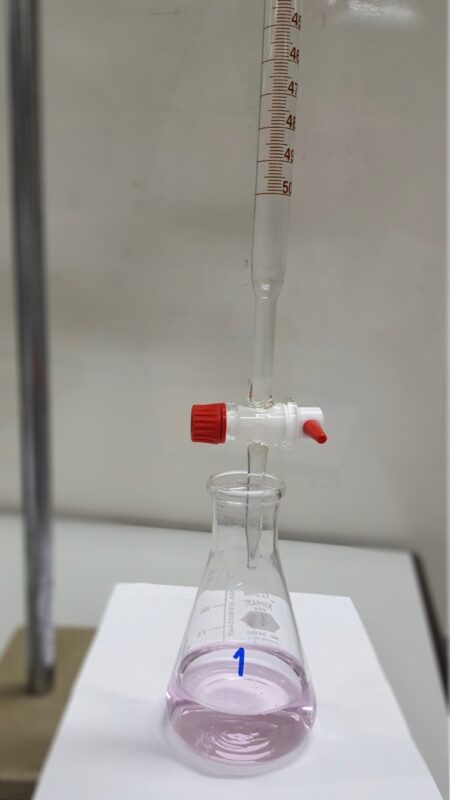
Both processes speed up with heat, light, air, moisture and contact with metals like copper and iron. Slow them down and you stretch the shelf life of sunflower oil, soybean and canola. Our guide to free fatty acid and peroxide value explains the two lab tests that track them.
Why high oleic oils last longer
The shelf life of sunflower oil depends a lot on its fatty acid makeup. Regular sunflower oil is rich in linoleic acid, a polyunsaturated fat with two double bonds that oxygen can attack. High oleic sunflower oil replaces most of that with oleic acid, which has only one. Fewer weak spots means slower oxidation.
Our high oleic sunflower oil has at least 80% oleic acid and 10% or less linoleic acid, with a peroxide value of max 5 meq/kg at shipment. That’s why its shelf life is 18 to 24 months instead of 12 to 18.
The same logic applies to soybean. Regular soybean oil has lots of linoleic acid and some linolenic acid, which has three double bonds and oxidises fastest of all. High oleic soybean oil has at least 70% oleic acid and 3% or less linolenic acid, which is why it also carries 18 to 24 months.
Canola sits between the two. It already has a good share of oleic acid, and its very low peroxide value at shipment (≤ 1.0 meq O₂/kg for our RBD grade) gives it a long starting runway.
Shelf life of sunflower oil: the full spec
Here are the numbers on our refined sunflower oil. The low peroxide and moisture limits at shipment are what give it its shelf life.
| Parameter | Refined sunflower oil |
|---|---|
| Colour | Clear, light golden yellow |
| Free fatty acids | Max 0.1% (as oleic) |
| Moisture and volatile matter | Max 0.1% |
| Peroxide value | Max 10 meq/kg |
| Iodine value | 118 – 144 |
| Unsaponifiable matter | Max 1.5% |
| Smoke point | Approx. 232°C (450°F) |
| Shelf life | 12 – 18 months |
Soybean and canola specs
| Parameter | Refined soybean oil | Refined canola oil | RBD canola oil |
|---|---|---|---|
| Free fatty acids | ≤ 0.1% | ≤ 0.1% | ≤ 0.05% |
| Moisture | ≤ 0.10% | ≤ 0.1% (with impurities) | ≤ 0.1% (with impurities) |
| Peroxide value | ≤ 10 meq O₂/kg (typical ≤ 5) | ≤ 2.0 meq O₂/kg | ≤ 1.0 meq O₂/kg |
| Iodine value | 120 – 141 | 105 – 126 | 105 – 126 |
| Shelf life | 12 – 18 months | 12 – 18 months | 18 – 24 months |
If you want to compare how these two behave in a fryer rather than a warehouse, see our guide to canola oil vs soybean oil.
What shortens shelf life
These are the things that eat into the shelf life of sunflower oil, soybean and canola most. Keep them in check and the oil lasts:
- Heat. A hot warehouse is the biggest enemy. As a rough rule, oxidation roughly doubles with every 10°C rise.
- Light. Clear bottles under bright shop lights or sunlight oxidise much faster.
- Air. Half-empty tanks and containers left open let in fresh oxygen.
- Moisture. Condensation in tanks or drums, or leaks, raise free fatty acids.
- Metals. Copper and brass fittings, or rusty steel, speed oxidation.
- Contamination. Mixing old oil with new, or using dirty containers.
How to store bulk oil
Bulk storage has the biggest effect on the shelf life of sunflower oil, because the volumes are large and the oil often sits for weeks. For flexitanks, ISO tanks and storage tanks:
- Unload promptly. Don’t leave a flexitank sitting in a hot container yard for weeks.
- Use clean, dry, stainless steel tanks where possible.
- Keep tanks as full as practical, or blanket the headspace with nitrogen to cut oxygen contact.
- Keep storage temperature moderate. For liquid oils like sunflower, soybean and canola, avoid heating them unless needed.
- Fit breathers with desiccant on tank vents to keep moisture out.
- Test on receipt and every few months for FFA and peroxide value.
For more on bulk transport, see our comparison of flexitank vs ISO tank. Palm oil has its own storage rules because it goes solid. Our guide on refined palm oil storage and handling covers those.
How to store packed oil
Packed oil needs care too if you want to get the full shelf life of sunflower oil. For bottles, tins, jerrycans and drums:
- Keep cartons closed until the oil goes on the shelf.
- Store off the floor, away from walls, in a cool, dry warehouse.
- Keep away from windows and heat sources like roofs in hot climates.
- Stack by production date and ship out oldest first.
- Keep caps and bungs tight. Once opened, use within a few months.
- Don’t store near strong smells like fuel or chemicals. Oil can pick them up.
Best-before dates and batch codes
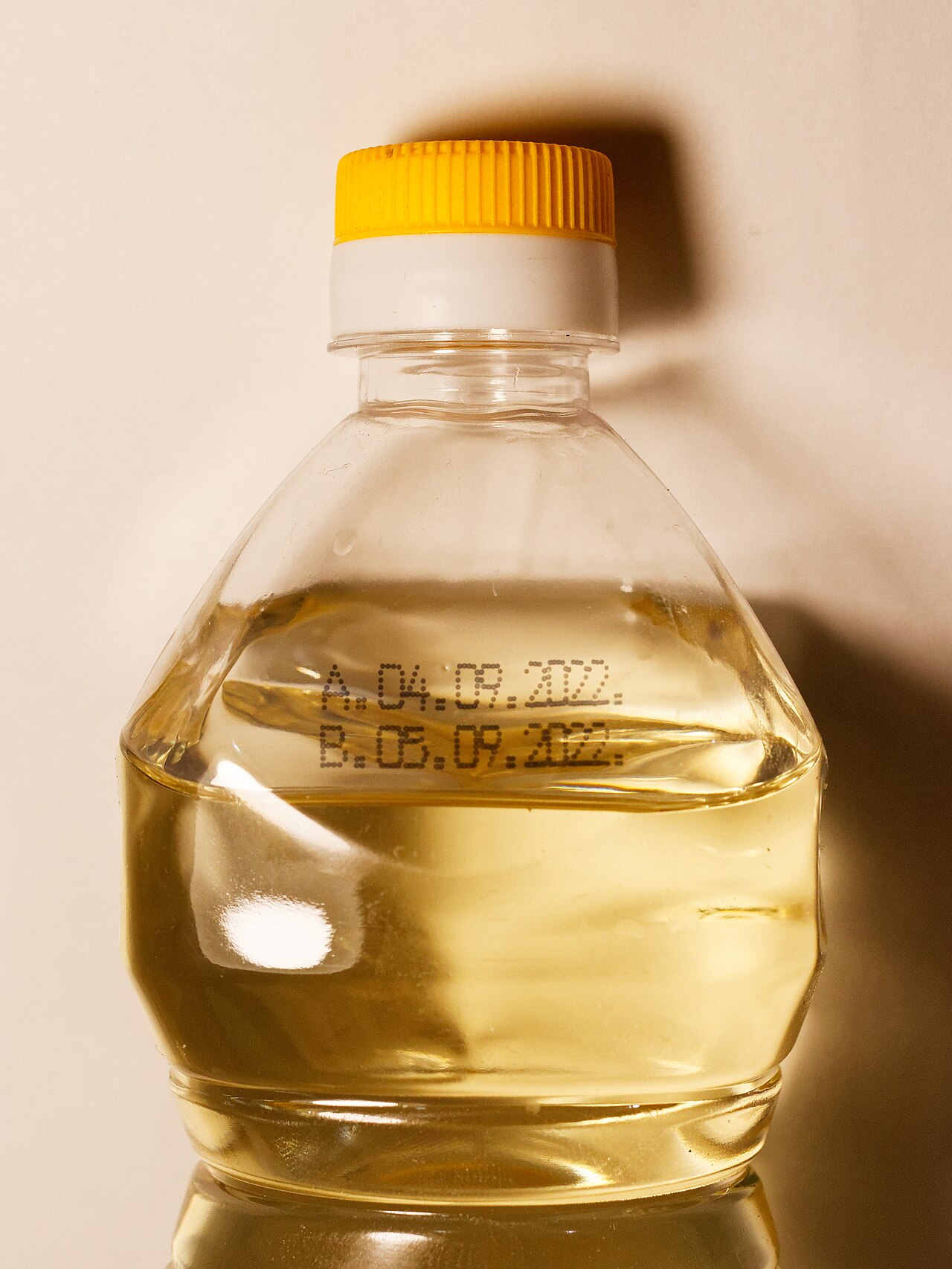
Packed oil should carry a production date or batch code and a best-before date. Match them to the certificate of analysis for that lot. The best-before date assumes proper storage. Poor storage can make oil go off before the date. Good storage often means it’s still fine a little after.
If you repack bulk oil into your own bottles, your best-before date should count from when the oil was made, not when you filled the bottle. Ask us for the production date of each lot so you can set your labels correctly.
How to tell if oil has gone off
Even within the shelf life of sunflower oil on the label, bad storage can turn it early. Before the lab results come back, your nose is a good first check. Signs of rancid oil:
- A stale, painty, fishy or cardboard smell.
- A bitter or sharp taste.
- Darker colour than when it arrived.
- Cloudiness in oils that should be clear (though sunflower, soybean and canola can cloud if they get very cold, and that clears when warmed).
For a proper answer, test free fatty acid and peroxide value. If peroxide value has climbed well above the level at shipment, oxidation is under way.
Opened containers
The shelf life of sunflower oil, soybean and canola drops once a container is opened. Air gets in every time. For opened tins and jerrycans in a kitchen, aim to use them within one to three months, kept closed, cool and away from the stove. For opened bulk tanks, test more often.
Planning orders around shelf life
The simplest way to make use of the full shelf life of sunflower oil and avoid waste is to match order size to use. If you use 20 tonnes of refined sunflower oil a month, a single container every month keeps stock fresh. Ordering six months’ worth at once to save on freight can backfire if half of it sits in a warm warehouse through summer.
If you need longer storage, for example for a distributor serving remote areas, choose a high oleic or RBD grade. The longer shelf life of those grades gives you more room.
Shelf life of sunflower oil in hot climates
Most shelf life figures, ours included, assume a cool, dry store. Many buyers are in hot countries where warehouse temperatures run well above that for much of the year. In those conditions, the real shelf life of sunflower oil can be noticeably shorter than the label suggests.
Some practical steps for hot climates:
- Order more often, in smaller lots, so stock turns over before the hot months do damage.
- Choose high oleic sunflower oil if you need to hold stock for a long time. Its stability buys you margin.
- Store bottles in cartons, away from metal roofs and sunny walls, which can get far hotter than the air.
- Avoid leaving containers in the port in summer. Clear them quickly.
- Test a sample every couple of months for peroxide value. It’s the early warning.
Soybean oil is even more sensitive to heat than regular sunflower, so the same rules apply with more force. Canola sits in between.
How the three compare with palm and coconut oil
It helps to see where the shelf life of sunflower oil sits against the other oils we sell:
| Oil | Typical shelf life (refined, unopened) | Main reason |
|---|---|---|
| Refined sunflower oil | 12 – 18 months | High in polyunsaturated fat |
| High oleic sunflower oil | 18 – 24 months | Mostly oleic acid |
| Refined soybean oil | 12 – 18 months | High in linoleic and some linolenic acid |
| Refined canola oil | 12 – 18 months | Mixed profile, some linolenic acid |
| RBD canola oil | 18 – 24 months | Very low starting peroxide value |
| Refined palm oil CP8 / CP10 | 12 – 18 months | Stable fat, but can pick up FFA |
| RBD coconut oil | 18 – 24 months | Mostly saturated fat |
Coconut oil is the most resistant to oxidation. Palm oil is stable too, though crude palm oil needs care because its free fatty acids rise quickly after harvest. Sunflower, soybean and canola are the most sensitive of the group, which is why storage matters so much for them.
Shelf life of sunflower oil on the supermarket shelf
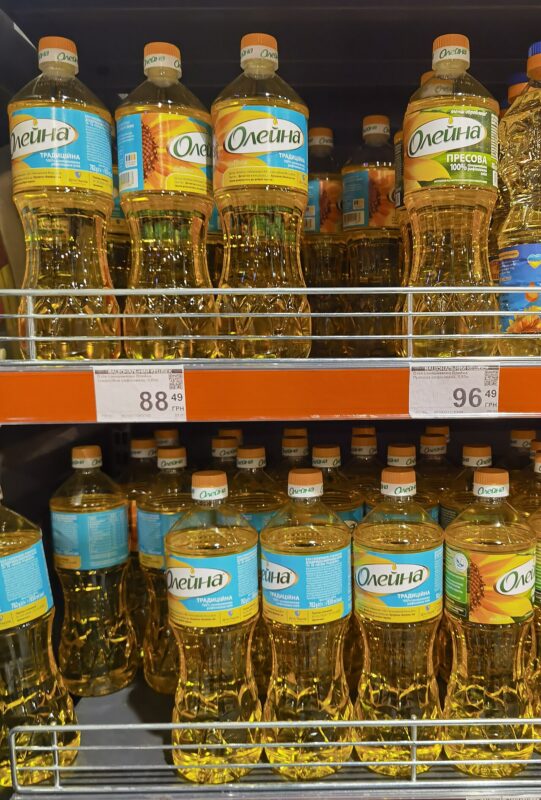
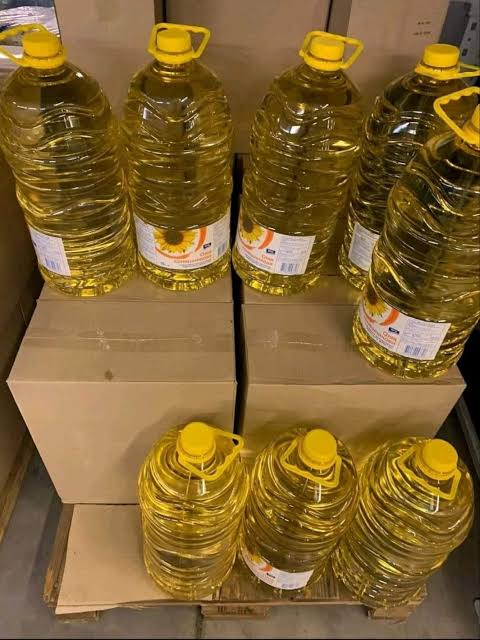
For retail, the shelf life of sunflower oil depends on the bottle as much as the oil. Clear PET is common because shoppers like to see the golden colour, but it lets light through. Under bright shop lights, oxidation speeds up.
A few things that help retail oil last:
- Fill bottles near the top to cut the air gap.
- Use tinted bottles or outer cartons if your market accepts them.
- Rotate stock so older bottles sell first.
- Keep back-room stock in cartons until it goes on display.
- Avoid display spots near windows or heat.
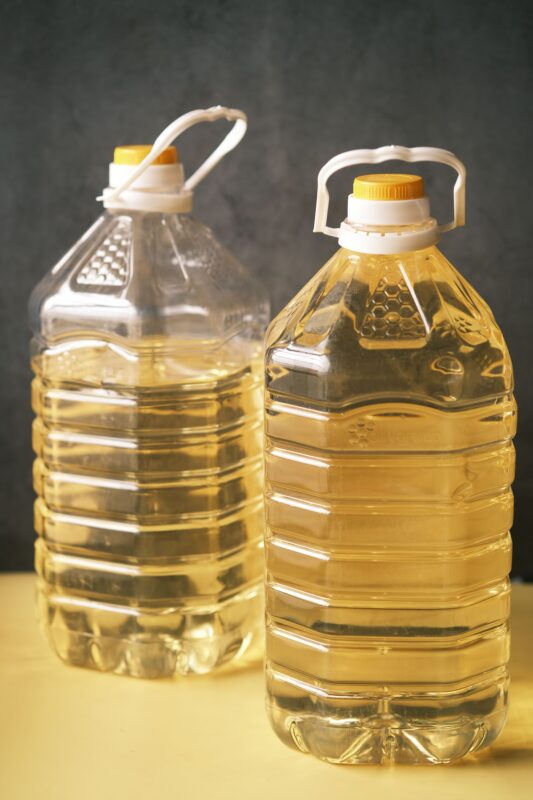
We fill 1 L, 5 L and 10 L PET bottles, and you can ask us about private label packing. Tell us how long your bottles typically sit in the supply chain, and we’ll suggest the right grade.
Shelf life of the oil inside finished food
Food manufacturers have a second shelf life to think about: the oil inside their product. Chips, crackers, biscuits, instant noodles and fried snacks all carry oil, and that oil keeps oxidising in the packet. When it goes rancid, the whole product tastes stale, even if the packet looks fine.
This is where the shelf life of sunflower oil and its fat makeup really matter. Snack makers often move from regular sunflower or soybean oil to high oleic oils or palm olein for exactly this reason. The finished product lasts longer on the shelf. If you’re working on a product with a long best-before date, ask us for a high oleic or RBD grade and the fatty acid profile.
Shelf life of sunflower oil during shipping
The clock starts at the refinery, not when the oil reaches you. A few weeks at sea, plus time in ports and on the road, all count against the shelf life of sunflower oil. On long routes through hot regions, that time can take a real bite.
Things that protect the oil in transit:
- Low peroxide value at loading. The fresher the oil starts, the more margin you have.
- Full flexitanks or sealed ISO tanks, so there’s little air in contact with the oil.
- Clean, dry containers so no moisture gets in.
- Fast clearance at the destination port, so containers don’t bake in the yard.
Compare the peroxide value on our certificate of analysis at loading with your own test on arrival. A small rise is normal. A big jump tells you the oil got hot or had too much air along the way.
A storage checklist you can pin up
- Warehouse cool, dry and out of direct sun.
- Cartons closed and stacked off the floor.
- Tanks clean, dry and kept as full as practical.
- No copper or brass in contact with the oil.
- Stock rotated by production date, oldest out first.
- Caps, bungs and hatches closed tight.
- Peroxide value and FFA tested on arrival and every few months.
- Anything with an off smell set aside and tested before use.
Follow that list and you’ll get close to the full shelf life of sunflower oil, soybean and canola on the spec sheet.
Common mistakes
- Buying a year’s stock at once to save on freight, then storing it through a hot season.
- Leaving tanks half full for weeks.
- Storing bottles in a sunny loading bay.
- Topping up old oil with new in the same tank, which mixes stale oil into fresh.
- Setting repack best-before dates from the filling date instead of the production date.
Any one of these can cut the real shelf life of sunflower oil by months.
Frying changes everything
Once oil goes into a fryer, shelf life stops being the issue. Hot oil breaks down in days, not months. For kitchens, the useful question becomes how often to change fryer oil. Our cooking oil smoke point chart also shows how each oil handles heat.
Standards and testing
International quality limits that underpin the shelf life of sunflower oil, soybean and canola are set by the FAO/WHO Codex Alimentarius standard for named vegetable oils. Many national rules and contracts follow it, and bulk trade contracts often use the rules of FOSFA. For shipments, an independent check at loading confirms the oil starts its life in good condition. See our guide to pre-shipment inspection for edible oil.

Quick answers
What’s the shelf life of sunflower oil? 12 to 18 months for refined sunflower oil, 18 to 24 months for high oleic, unopened and stored cool and dry.
What’s the shelf life of soybean oil? 12 to 18 months for refined, 18 to 24 months for high oleic. Crude soybean oil is about 6 months.
What’s the shelf life of canola oil? 12 to 18 months for refined, 18 to 24 months for RBD canola.
Can oil be used after the best-before date? Often, if it’s been stored well and still smells and tastes normal. For commercial use, test it first.
Does refrigeration help? It slows oxidation, but it’s not practical for bulk. Cool, dark storage is enough for most needs.
Order long-life cooking oil from DTH Company Ltd
We supply sunflower oil, soybean oil, canola oil, palm oil and coconut oil to buyers worldwide, with a certificate of analysis on every lot. If shelf life is a priority, ask us about our high oleic and RBD grades.
Browse our products page, read about us, or send your grade, quantity and destination through our contact page.
One thought on “Shelf Life of Sunflower Oil, Soybean and Canola: 7 Proven Storage Tips”