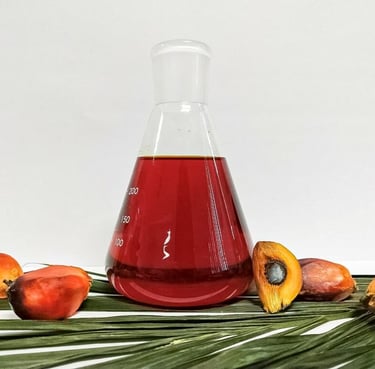
If you run a noodle line, you already know the frying oil is the biggest single ingredient cost after flour, and it decides how your noodles taste on day 300 of shelf life. We supply palm oil for instant noodle manufacturing to factories around the world: RBD palm oil, palm olein and custom blends, loaded in flexitank, ISO tank or drums, with the specs and certificates a food plant needs. This page covers what we sell, what to ask for, and how to keep your oil cost under control.

Table of Contents
What We Supply for Noodle Frying
Most noodle makers end up using one of three types of palm oil for instant noodle manufacturing. We stock all of them.
- RBD palm oil (IV 50 to 55). The classic noodle frying fat. It’s semi solid at room temperature, so the fried cake feels dry and not greasy, and it holds up well over long frying runs.
- RBD palm olein CP10 or CP8. The liquid fraction of palm oil. Easier to pump and handle in cooler climates, and some factories prefer the softer mouthfeel. See our CP10 palm olein and CP8 palm olein pages.
- Noodle frying blends. Palm oil with a little palm stearin to raise the melting point, or palm olein blended for a specific slip melting point. We blend to your target.
All of our palm oil for instant noodle manufacturing is food grade, refined, and available halal certified. If you’re still choosing between grades, our posts on CP8 vs CP10 palm oil and palm stearin vs palm olein are a good place to start.
Why Palm Oil for Instant Noodle Manufacturing Is the Industry Standard
Walk into almost any noodle plant in Asia, Africa or Latin America and you’ll find palm in the fryer. There are good reasons for that, and they’re mostly practical.
It’s stable at frying heat
Instant noodles are fried at around 140 to 160°C for one to two minutes, on lines that run around the clock. Palm oil is low in polyunsaturated fat, so it oxidises much more slowly than soybean or sunflower oil. That means the oil lasts longer in the fryer and the noodles don’t go rancid on the shelf.
It gives a dry, crisp noodle
Because palm oil is partly solid at room temperature, the fat that stays in the noodle sets firm. The block feels dry in the pack, doesn’t leave oil on the wrapper, and cooks up with a good bite. Liquid oils tend to give a greasier feel.
It’s cost effective
Palm is usually one of the cheapest vegetable oils on the market, and it’s available all year. When you’re frying tens of tons a day, a small difference per ton adds up fast.
It needs no hydrogenation
Palm is naturally semi solid, so you get the texture you want without partially hydrogenated fats or trans fat. That matters for labels in a lot of markets.
That’s why palm oil for instant noodle manufacturing has been the default choice for decades, and why most large brands still use it. If you want the broader picture of the product, the instant noodle article on Wikipedia gives a decent history, and the World Instant Noodles Association publishes demand figures by country.
Our Specifications: RBD Palm Oil for Noodle Frying
This is the spec we ship as standard for palm oil for instant noodle manufacturing. Each load is checked by an independent surveyor at loading and comes with a certificate of analysis.
| Parameter | RBD palm oil (noodle grade) |
|---|---|
| Free fatty acid (as palmitic) | Max 0.1% |
| Moisture and impurities | Max 0.1% |
| Peroxide value | Max 1.0 meq/kg at loading |
| Iodine value (Wijs) | 50 to 55 |
| Slip melting point | 33 to 39°C |
| Colour (Lovibond 5¼”) | Max 3.0 red |
| Smoke point | Around 230°C |
| Odour and taste | Bland, clean |
| 3-MCPD esters | Low level grades available on request |
| Glycidyl esters | Low level grades available on request |
Our Specifications: RBD Palm Olein for Noodle Frying
| Parameter | RBD palm olein CP10 | RBD palm olein CP8 |
|---|---|---|
| Free fatty acid | Max 0.1% | Max 0.1% |
| Moisture and impurities | Max 0.1% | Max 0.1% |
| Iodine value | Min 56 | Min 58 |
| Cloud point | Max 10°C | Max 8°C |
| Peroxide value | Max 1.0 meq/kg | Max 1.0 meq/kg |
| Colour (Lovibond 5¼”) | Max 3.0 red | Max 3.0 red |
For a deeper look at olein grades, see our RBD palm olein supplier page and the guide to double fractionated palm olein.
Choosing the Right Palm Oil for Instant Noodle Manufacturing
There’s no one perfect grade of palm oil for instant noodle manufacturing. It depends on your line, your climate and what your customers expect. Here’s how we usually help factories decide.
Your climate
In hot countries, RBD palm oil is easy to keep liquid in heated tanks and gives the driest noodle. In cooler places, palm olein is easier to handle because it won’t set solid in pipes and storage as quickly. Some plants in colder regions run olein in winter and switch to palm oil in summer.
Your product
Bagged noodles, cup noodles and snack noodles all behave a little differently. Cup noodles often need a firmer fat so the block holds its shape. Snack noodles eaten straight from the pack need good crispness. Tell us what you make and we’ll suggest a starting grade.
Your export markets
If you sell into Europe or other markets with strict limits on process contaminants, ask for low 3-MCPD and glycidyl ester oil. It costs a little more but it saves a lot of trouble later. The European Food Safety Authority sets the context here, and many retailers now ask for test reports on every lot.
Your certification needs
Most of our noodle customers need halal. Some need RSPO, MSPO or ISPO certified palm oil for their own customers’ sustainability policies. We can supply all of them. See our pages on halal certified palm oil, MSPO certified palm oil and ISPO certified palm oil. Details of the RSPO scheme itself are on the RSPO website.
How Much Oil Does a Noodle Line Use?
Fried instant noodles usually pick up somewhere between 15% and 22% fat by weight. So for every ton of finished noodles, you’re going through roughly 150 to 220 kg of oil, plus a bit for top ups and losses.
| Daily noodle output | Approx. oil used per day | Approx. oil per month (26 days) |
|---|---|---|
| 10 MT | 1.7 to 2.3 MT | 45 to 60 MT |
| 30 MT | 5 to 7 MT | 130 to 180 MT |
| 60 MT | 10 to 14 MT | 260 to 360 MT |
That’s why most factories buy palm oil for instant noodle manufacturing on a monthly program rather than one container at a time. A plant making 30 tons of noodles a day needs six to nine flexitanks a month.
Palm Oil for Instant Noodle Manufacturing vs Other Frying Oils
We sell soybean, sunflower and canola oil too, so we’re not trying to push palm for the sake of it. But when noodle makers ask us to compare, this is how it usually comes out.
| Oil | Frying stability | Noodle texture | Shelf life of finished noodles | Typical cost |
|---|---|---|---|---|
| RBD palm oil | Very good | Dry, firm, crisp | Long | Low |
| RBD palm olein | Good | Slightly softer | Long | Low |
| High oleic sunflower oil | Very good | Oilier feel | Good | High |
| Soybean oil | Fair | Oily | Shorter | Medium |
| Canola oil | Fair to good | Oily | Medium | Medium |
Some brands selling to health focused markets do use liquid oils or a mix, and they pay for it in cost and shelf life. For most factories, palm oil for instant noodle manufacturing still gives the best balance. If your buyers ask for palm free products, we can talk you through the alternatives, and our post on high oleic sunflower oil for frying covers the best liquid option. If you want to understand the fat profile, see palm oil saturated fat content.
Packing and Delivery
We ship palm oil for instant noodle manufacturing in whatever format suits your plant.
| Packing | Net oil per unit | Notes |
|---|---|---|
| Flexitank in 20ft | 20 to 22 MT | Most common. Needs heating at discharge in cool weather. |
| ISO tank | 20 to 24 MT | Heated, reusable, good for regular routes. |
| Bulk vessel parcel | 500 MT and up | For very large plants with port tanks. |
| 190 kg drums | About 15 MT per 20ft | For smaller lines without bulk tanks. |
| 20 kg cartons (blocks) | About 18 MT per 20ft | Solid frying fat, easy to store. |
Palm oil sets solid in cool weather, so a flexitank usually needs a heating pad or steam coil at your end. Our guide on how to unload palm oil from a flexitank walks through it, and flexitank vs ISO tank compares the two bulk options.
Looking After Frying Oil on the Line
Good palm oil for instant noodle manufacturing in the tank is only half the job. How you run the fryer decides how long it lasts. A few things we’ve learned from customers over the years:
- Keep the turnover high. On a well run noodle line, fresh oil replaces what the noodles absorb, so the whole fryer volume turns over in a few hours. That keeps quality steady.
- Don’t overheat. Every extra 10°C speeds up breakdown. Run as cool as your product allows.
- Filter continuously. Crumbs and flour fines burn and darken the oil.
- Check FFA and polar compounds. Test daily. When numbers creep up, look at turnover and temperature before blaming the oil.
- Store bulk oil properly. Heated tanks should be kept just above melting point, not hot. Nitrogen blanketing helps a lot.
For fryers in general, our article on how often to change fryer oil has more detail.
What Drives the Price of Palm Oil for Instant Noodle Manufacturing
Palm prices follow the Malaysian futures market and Indonesian export policy closely. Through 2026 prices have been firm, helped by strong crude oil prices and Indonesia’s biodiesel blending program, which keeps a lot of palm off the export market. The Malaysian Palm Oil Board publishes monthly stock and export data that most traders watch.
For a noodle factory, the practical points are simple:
- Refined grades cost more than crude, and low contaminant grades cost a little more again.
- Certified oil (RSPO, MSPO, ISPO) carries a small premium.
- Heated ISO tanks cost more than flexitanks to ship, but less oil is lost at discharge.
- Monthly contracts usually beat one off spot buying.
For current numbers, see our RBD palm olein CP10 bulk price guide or just ask us for a quote. If you import refined palm for the first time, read how to import refined palm oil CP10.
Quality Control and Documents
A noodle factory can’t afford a bad load. One tank of oxidised oil can mean thousands of cartons with a short shelf life. So every shipment of palm oil for instant noodle manufacturing from us comes with:
- Certificate of analysis from the refinery
- Independent quality and quantity inspection at loading (SGS, Intertek or similar)
- Certificate of origin
- Halal certificate
- Sustainability certificate where ordered (RSPO, MSPO or ISPO)
- Test reports for 3-MCPD and glycidyl esters on low contaminant grades
- Bill of lading, invoice and packing list
If your market is in the EU, you’ll also need to think about deforestation rules. Our post on EUDR palm oil compliance explains what that means for buyers.
7 Proven Tips for Buying Palm Oil for Instant Noodle Manufacturing
- Agree the spec in writing. FFA, peroxide value, iodine value, slip melting point and colour at minimum. Add 3-MCPD and GE limits if you export.
- Test a sample on your own line. Lab numbers don’t tell you how the noodle feels. Run a trial batch and do a shelf life test before you sign a big contract.
- Buy on a program. Monthly loadings over three to six months give you supply security and a better price than spot buying.
- Match packing to your plant. If you have heated tanks, buy bulk. If not, drums or cartons cost more per ton but save you from a costly mess at discharge.
- Plan for the cold. If your winters are cool, order heating for the flexitank or switch to olein for those months.
- Keep two grades approved. Having palm oil and palm olein both qualified on your line gives you options when one gets expensive.
- Work with a supplier who answers. When a ship is delayed, you need someone who picks up the phone and finds you oil to cover the gap. That’s worth more than a few dollars a ton.
Who We Work With
We supply palm oil for instant noodle manufacturing to large branded producers and small regional plants alike. Some buy one flexitank a month, some buy several hundred tons. We ship to Asia, the Middle East, Africa, Europe, and Latin America, and anywhere else with a container port. We also supply other oils for food plants, which you can see on our products page, and our main palm oil page lists every palm grade we sell.
Common Frying Problems and What Usually Causes Them
When a noodle plant calls us about a problem, it’s usually one of these. Not every issue is the oil, but it’s worth ruling it out.
| Problem | Likely cause | What to check |
|---|---|---|
| Noodles taste rancid after a few months | High peroxide value in the oil, or oil abused in the fryer | PV at delivery, fryer temperature, oil turnover |
| Greasy noodle blocks | Oil too soft for the climate, or poor de-oiling | Slip melting point, cooling section |
| Dark colour on noodles | Burnt fines, old oil, high temperature | Filtration, oil colour, fryer settings |
| Foaming in the fryer | Oil breakdown, soap or contamination | Polar compounds, cleaning residues |
| Oil set solid in the pipes | Cold weather, no tracing on lines | Tank and pipe heating, switch to olein |
If you’re seeing any of these, send us your COA and fryer data. We’ve helped plenty of customers fix problems that had nothing to do with the oil itself. Good palm oil for instant noodle manufacturing only works as well as the line it goes into.
Setting Up Supply for a New Noodle Plant
We get a fair number of enquiries from groups building their first noodle factory. If that’s you, a few things are worth sorting out early, before the line arrives.
First, decide on storage. Bulk palm oil for instant noodle manufacturing is far cheaper than drums, but you need heated tanks, a pump and some pipe tracing. A couple of 50 ton tanks is a common starting point for a mid size plant. Second, think about your discharge. If the plant is far from the port, you’ll need tanker trucks or you’ll have to truck the flexitank containers inland, which works but needs heating on arrival. Third, line up your certificates. Halal, food safety and any sustainability scheme you need should be in place before your first export order, because your own customers will ask for them.
We can help with all of this. We’ve seen a lot of plants start up, and we’re happy to share what worked and what didn’t.
How an Order Works With Us
- You send your requirement: grade, quantity, packing, port and any certificates you need.
- We send a firm offer and a spec sheet, with a validity date.
- We send a sample if you need one for line trials.
- You confirm, we issue a contract, and payment terms are agreed (LC or deposit plus balance).
- We book the container or tank and schedule loading.
- The surveyor inspects and samples at loading.
- We send the full document set so you can clear customs on arrival.
That’s it. No surprises. For repeat buyers of palm oil for instant noodle manufacturing, we set this up once and then just confirm volumes and dates each month.
Why Factories Stay With Us
Noodle producers don’t switch suppliers lightly. Once a frying oil works on the line, nobody wants to risk changing it. The factories that buy palm oil for instant noodle manufacturing from us tend to stay because the oil is the same every time, the documents are right, and we tell them early if a shipment is going to be late. We’d rather give bad news on Monday than have a customer find out on Friday.
We also keep an eye on the market for our regular buyers. If palm looks set to rise, we’ll say so, and you can decide whether to cover extra months. If it’s softening, we’ll tell you that too. It’s simple stuff, but it’s what most buyers say they don’t get elsewhere. Reliable palm oil for instant noodle manufacturing, at a fair price, from people who know frying, is really all we’re trying to offer.
One last thing on price. When you compare quotes for palm oil for instant noodle manufacturing, check whether they include the low contaminant spec, the certificates you need, and heating at discharge. A cheaper offer that leaves those out often ends up costing more by the time the oil is in your fryer.
Frequently Asked Questions
Which is better for noodles, palm oil or palm olein?
Palm oil gives a drier, firmer noodle and lasts very well in the fryer. Palm olein is easier to handle and gives a slightly softer bite. Many plants use palm oil in warm months and olein when it’s cold.
Can you supply low 3-MCPD palm oil?
Yes. We offer reduced 3-MCPD and glycidyl ester grades with test reports on each lot.
Is your palm oil halal?
Yes, every load of palm oil for instant noodle manufacturing we ship can come with a halal certificate.
What’s the minimum order?
One 20ft container of palm oil for instant noodle manufacturing. For regular supply, we set up a monthly program.
Do you add antioxidants?
Only if you ask. Some customers want TBHQ or tocopherol added at the refinery, others add their own. We follow your specification and local rules.
How long does delivery take?
Loading is usually one to three weeks from a confirmed order, then sea transit to your port.
Get a Quote for Palm Oil for Instant Noodle Manufacturing
Tell us your daily noodle output, the grade you use now (or want to try), your packing preference and your destination port. We’ll send a firm price, a full spec sheet and a sample, usually within one working day.
Email info@dthcompanyltd.com, call or WhatsApp +66 91 765 9104, or fill in the form on our contact page. We know noodle lines don’t stop, so we don’t make you wait for an answer.