

Buyers ask us about refined vs cold pressed sunflower oil almost every week. Usually it’s a shop owner who wants a premium line, a restaurant that’s had a customer ask for “natural” oil, or a food brand trying to decide what goes on the label. We supply both grades, in bulk and in bottles, so we’ve got no reason to push one over the other. This guide explains how each one is made, how they differ in taste, colour, smoke point and shelf life, what each costs, and which one actually makes sense for your business. You’ll also find our specs and packing options, and how to get a quote.

Short version first. Refined oil is the workhorse: neutral, stable, cheap enough for daily frying. Cold pressed oil is the specialty product: more flavour, more natural compounds, more expensive and not great for high heat. The rest of this page is the detail behind that, so you can make the call on refined vs cold pressed sunflower oil with your eyes open.
Table of Contents
What Is Refined Sunflower Oil?
Refined sunflower oil starts with sunflower seeds that are cleaned, cracked, conditioned with heat and pressed. The leftover cake is then washed with a food-grade solvent, usually hexane, to pull out the rest of the oil. That combined oil is called crude oil, and it isn’t ready to eat yet.
The crude oil goes through several steps:
- Degumming to remove phospholipids
- Neutralizing to take out free fatty acids
- Bleaching with clay to remove colour and traces of metals
- Winterizing, or chilling, to remove waxes that would make the oil cloudy in the cold
- Deodorizing with steam under vacuum to strip out smells and flavours
What you get at the end is clear, pale yellow oil with almost no taste or smell. It has a high smoke point and keeps well for a long time. If you want to see the difference between the crude stage and the finished oil, our guide to crude vs refined sunflower oil goes through it.
What Is Cold Pressed Sunflower Oil?
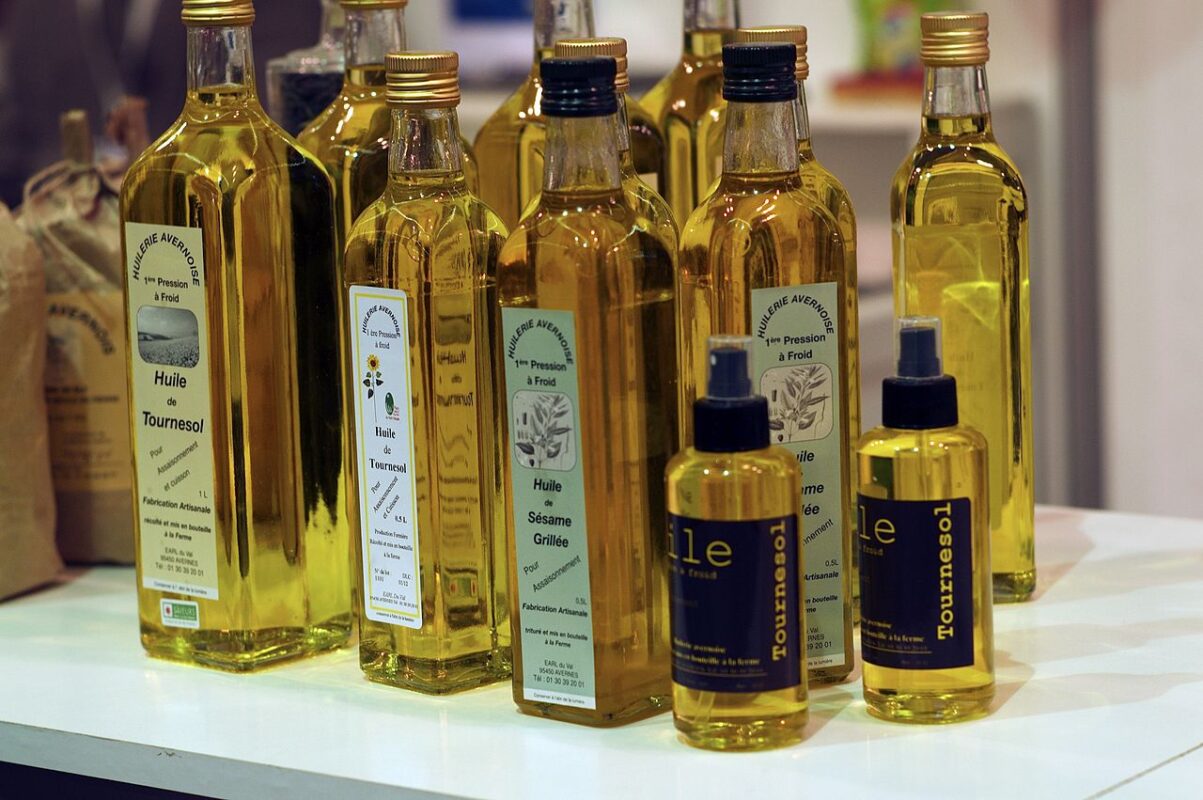
Cold pressed sunflower oil is made by squeezing the seeds in a mechanical press without adding outside heat. The press still warms up from friction, but good producers keep the oil temperature low, usually under about 40 to 50 °C. No solvent is used and the oil isn’t refined. It’s simply filtered, sometimes settled for a few days, and bottled.
The result is golden to amber oil with a nutty, seedy taste. It keeps more of the natural vitamin E, plant sterols and other minor compounds. It also keeps more of the things that make oil break down faster, like free fatty acids and traces of moisture.
One point people often mix up: cold pressed oil is not the same as crude oil. Crude oil from a solvent plant is meant to be refined before anyone eats it. Cold pressed oil is made to be eaten as it is, from carefully cleaned seed, under food-grade conditions. When we talk about refined vs cold pressed sunflower oil, we mean two finished, edible products.
Refined vs Cold Pressed Sunflower Oil: Side by Side
Here’s the comparison most buyers want. Figures are typical ranges, not promises for every batch.
| Feature | Refined sunflower oil | Cold pressed sunflower oil |
|---|---|---|
| How it’s made | Pressing plus solvent extraction, then full refining | Mechanical pressing only, filtered |
| Colour | Pale, light yellow | Golden to amber |
| Taste and smell | Neutral | Nutty, seedy |
| Smoke point | About 225 to 230 °C | About 105 to 160 °C |
| Free fatty acid | 0.10% max | Usually 0.5% to 2% |
| Vitamin E | Lower, some lost in deodorizing | Higher |
| Shelf life | 18 to 24 months sealed | About 6 to 12 months sealed |
| Clarity in cold | Stays clear if winterized | Can go cloudy |
| Best uses | Frying, baking, food manufacturing, everyday cooking | Salads, dressings, drizzling, low-heat cooking |
| Relative price | Lower | Much higher |
That table covers 90 percent of the refined vs cold pressed sunflower oil question. The sections below explain why the numbers look the way they do.
Taste, Colour and Smell
Flavour is the first thing most people notice in refined vs cold pressed sunflower oil. Refined oil is meant to disappear in your food. That’s exactly why food factories, bakeries and restaurants like it. Your chips taste like potatoes, not like sunflower seeds.
Cold pressed oil tastes like the seed. Some people love that in a salad or drizzled over bread. Others find it too strong for frying or baking. If you’re thinking about refined vs cold pressed sunflower oil for a product where flavour matters, try both side by side before you decide.
Smoke Point and Cooking
This is where the two oils really part ways. Refined sunflower oil handles high heat well, which is why it’s one of the most common frying oils in the world. Our guide to whether sunflower oil is good for frying goes into more detail, and you can compare oils on our cooking oil smoke point chart.
Cold pressed oil starts to smoke much sooner because the free fatty acids and other natural compounds break down at lower temperatures. If you deep fry with it, it will smoke, taste bitter and break down quickly. Use it for gentle cooking or cold dishes instead. In kitchen terms, that’s the biggest practical gap in refined vs cold pressed sunflower oil.
For anyone weighing refined vs cold pressed sunflower oil for a restaurant or a fryer, the answer is almost always refined. If you want a longer fryer life, look at high oleic sunflower oil, which is refined but has a different fatty acid make-up that resists breakdown.
Nutrition: What Changes and What Doesn’t
The fatty acids are almost the same in both oils, because refining doesn’t change the basic fat. Regular sunflower oil is high in linoleic acid, an omega 6 fat, with oleic acid as the next biggest part. Calories are the same too, roughly 884 kcal per 100 g, as the USDA FoodData Central database shows for most vegetable oils.
What changes are the minor compounds. Cold pressed oil keeps more:
- Vitamin E (tocopherols)
- Plant sterols
- Natural colour pigments
- Some phenolic compounds
Refining removes some of these, especially in the deodorizing step. That said, refined sunflower oil is still a good source of vitamin E compared with many oils. Our page on sunflower oil vitamin E has the numbers.
We’d be careful with big health claims either way. The nutrition gap in refined vs cold pressed sunflower oil is real but modest. Check your local labelling rules before printing claims on your bottles.
Shelf Life and Storage
Refined oil keeps for 18 to 24 months in a sealed bottle stored somewhere cool and dark. Once opened, it’s best used within a few months.
Cold pressed oil is more delicate. Expect around 6 to 12 months sealed, and a lot less once opened, especially in a warm kitchen. Keep it away from light, ideally in dark glass or opaque bottles, and don’t buy more than you can sell in a reasonable time.
For anyone stocking shelves, this is a real part of the refined vs cold pressed sunflower oil decision. Slow-selling cold pressed oil can go stale on the shelf, and that hurts your brand. Our guide to the shelf life of sunflower oil, soybean and canola has more storage tips.
Price: Why Cold Pressed Costs More
Cold pressed oil costs more for simple reasons:
- Lower yield. A press alone leaves a fair amount of oil in the cake. Solvent extraction gets most of it out.
- Better seed. Because nothing is refined out later, the seed has to be clean, dry and in good condition from the start.
- Smaller scale. Cold press plants are usually much smaller than big crushing and refining plants.
- Shorter shelf life. Producers and sellers carry more risk of stock going stale.
- Packaging. Cold pressed oil usually goes into smaller, dark bottles, which cost more per litre.
In bulk, cold pressed sunflower oil can cost well over the price of standard refined oil, and at retail the gap is often two to three times per litre or more. That’s why, when people compare refined vs cold pressed sunflower oil on cost alone, refined wins easily. Cold pressed only makes sense when the customer is willing to pay for it. Price is often where the refined vs cold pressed sunflower oil debate ends for big buyers. If you want a feel for refined oil pricing, see our sunflower oil wholesale price per ton guide.
Which One Should You Buy?
Here’s how we’d answer the refined vs cold pressed sunflower oil question for different buyers.
Supermarkets and wholesalers. Most of your volume should be refined oil in 1, 2, 3 and 5 litre bottles. If you have shoppers who pay for premium products, add a small line of cold pressed oil in 250 ml, 500 ml or 1 litre bottles.
Restaurants, hotels and caterers. Refined oil, or high oleic for frying. Keep a few bottles of cold pressed oil for salads and finishing if your menu calls for it.
Food manufacturers. Refined oil for almost everything: snacks, sauces, baked goods, canned food, margarine. Cold pressed only if your product is sold on that claim.
Cosmetics and soap makers. Both can work. Refined oil gives a neutral base, while cold pressed oil is often chosen for natural skin care. See our page on sunflower oil for soap making.
Health food shops and organic brands. Cold pressed, often organic. We also supply organic sunflower oil.
How Supply Works for Each Grade
There’s a practical side to refined vs cold pressed sunflower oil that buyers don’t always think about: how easy it is to get steady supply.
Refined oil comes from big crushing and refining plants that run around the clock. A single plant can turn out hundreds or thousands of tons a day. That means refined oil is easy to buy in full containers, prices follow the world market, and you can repeat the same quality month after month.
Cold pressed oil is a smaller world. Presses are slower, batches are smaller, and the quality depends heavily on the seed that came in that week. Two batches from the same press can taste a little different. That isn’t a flaw, it’s the nature of an unrefined product, but it does mean you should agree tolerances with your supplier and keep retained samples from each lot.
If you’re launching a product, plan for this. Lock in refined oil volumes for the year, and set up cold pressed oil as a smaller, more frequent order. When buyers ask us about refined vs cold pressed sunflower oil for a new brand, that’s usually the setup we suggest.
Building a Product Range With Both Oils
You don’t have to choose one. Many of our retail and wholesale buyers run both, and it works well when each oil has a clear job.
- Everyday line: refined sunflower oil in 1, 2, 3 and 5 litre PET, priced to move
- Premium line: cold pressed sunflower oil in 500 ml or 1 litre dark bottles, priced for margin
- Food service line: refined or high oleic oil in 10 and 20 litre jerrycans or 18 litre tins
This gives your shoppers a clear choice and lets you earn a better margin on the premium bottle without losing the volume from the everyday one. On the shelf, put them side by side with simple labels explaining refined vs cold pressed sunflower oil in a sentence or two. Shoppers appreciate it, and it saves your staff answering the same question all day.
Simple Checks You Can Do When Oil Arrives
You don’t need a full lab to spot obvious problems. When a shipment lands, open a few packs from different pallets and check:
- Colour. Refined oil should be pale and bright. Cold pressed should be golden, not dark brown.
- Smell. Refined oil should smell of almost nothing. Cold pressed should smell like sunflower seeds, not paint, cardboard or old nuts. Those are signs of rancidity.
- Clarity. Refined oil should be clear. Cold pressed can have a slight haze, especially when cold, but no thick sediment.
- Taste. A small taste on bread tells you a lot. Bitter or sharp means trouble.
If anything seems off, send a sample to a local lab for free fatty acid and peroxide value before you sell it. And keep your certificate of analysis handy so you can compare. These checks matter for both sides of the refined vs cold pressed sunflower oil choice, but they matter more for cold pressed because it’s less forgiving.
For general background on how vegetable oils are processed, the sunflower oil article on Wikipedia is a reasonable starting point.
Our Refined Sunflower Oil Specifications
Below are the numbers behind both products, so you can compare refined vs cold pressed sunflower oil on paper before you order.
| Parameter | Specification |
|---|---|
| Free fatty acid (as oleic) | 0.10% max |
| Peroxide value at loading | 2.0 meq/kg max |
| Moisture and volatile matter | 0.05% max |
| Insoluble impurities | 0.05% max |
| Colour (Lovibond 5¼ inch) | 3.0 Red max |
| Iodine value (Wijs) | 118 to 141 |
| Cold test | 5.5 hours min at 0 °C |
| Smoke point | About 225 °C |
| Shelf life | 18 to 24 months |
Full detail is on our refined sunflower oil specification page, and you can order on our refined sunflower oil product page.
Our Cold Pressed Sunflower Oil Specifications
| Parameter | Typical value |
|---|---|
| Process | Mechanical pressing, no solvent, no refining |
| Pressing temperature | Below about 45 °C oil temperature |
| Free fatty acid (as oleic) | 1.0% max typical |
| Peroxide value at packing | 10 meq/kg max |
| Moisture | 0.1% max |
| Colour | Golden to amber |
| Taste | Mild nutty sunflower flavour |
| Shelf life | 9 to 12 months sealed, away from light |
| Availability | On request, by bottle or bulk, organic option |
The Codex Alimentarius standard for named vegetable oils sets separate quality limits for refined oils and for cold pressed and virgin oils, and our products are made to meet them.
Packaging Options
| Pack | Refined | Cold pressed |
|---|---|---|
| 250 ml and 500 ml glass or PET | On request | Yes |
| 1 L PET or glass | Yes | Yes |
| 2 L, 3 L, 5 L PET | Yes | 5 L on request |
| 10 L and 20 L jerrycans | Yes | On request |
| 18 L tins | Yes | No |
| Drums, IBC, flexitank | Yes | Drums and IBC on request |
We can also pack under your brand. See private label vegetable oil for how that works.
7 Proven Tips for Buying Refined vs Cold Pressed Sunflower Oil
Tip 1: Start from how the oil will be used
High heat means refined. Cold dishes and premium shelves can mean cold pressed. Most problems with refined vs cold pressed sunflower oil come from using the wrong oil for the job.
Tip 2: Check the label claim
“Cold pressed” should mean no solvent and no refining. Ask your supplier to confirm the process in writing and keep it on file.
Tip 3: Ask for a fresh certificate of analysis
Free fatty acid and peroxide value tell you most of what you need to know about freshness. Our guide to free fatty acid and peroxide value explains what to look for.
Tip 4: Buy cold pressed in smaller lots
Because it doesn’t keep as long, it’s better to order cold pressed oil more often in smaller amounts. Refined oil can be bought in full containers. This is one of the most useful habits when buying refined vs cold pressed sunflower oil together.
Tip 5: Mind the packaging
Cold pressed oil needs dark or opaque packs and cool storage. Clear PET on a sunny shelf will spoil it quickly.
Tip 6: Watch for blending
Some cheap “cold pressed” oils are refined oil with a splash of pressed oil for colour. A lab test and a supplier you trust are your best protection. Read how to detect adulterated cooking oil.
Tip 7: Get samples of both
The easiest way to settle refined vs cold pressed sunflower oil for your customers is to taste and test both. We’re happy to send samples. See how to request edible oil samples.
Common Myths About Refined vs Cold Pressed Sunflower Oil
There’s a lot of half-truth online about refined vs cold pressed sunflower oil. Here are the ones we hear most.
“Refined oil is full of chemicals.” Properly refined oil is tested for solvent residues, and the limits are very strict. The finished oil is simply sunflower oil with the impurities taken out.
“Cold pressed oil is always healthier.” It keeps more minor nutrients, but the fat is the same. If you overheat it, it can actually produce more breakdown products than refined oil would.
“Cloudy oil has gone bad.” Not necessarily. Cold pressed oil can go cloudy in the cold because of natural waxes. It usually clears when it warms up. Refined oil stays clear because it’s winterized.
“All sunflower oil is the same.” No. The process, the seed variety and the freshness all matter. Our broader guide on refined oil vs unrefined oil covers other oils too.
Shipping and Documents
Whichever side of refined vs cold pressed sunflower oil you land on, delivery works the same way.
We ship worldwide. Minimum order for refined oil is usually one 20 foot container. Cold pressed oil can be added as part of a mixed load. Each shipment comes with a commercial invoice, packing list, bill of lading, certificate of origin, certificate of analysis, health certificate where needed, and halal certificate on request.
Frequently Asked Questions
What’s the main difference in refined vs cold pressed sunflower oil?
Refined oil is fully processed to be neutral and heat stable. Cold pressed oil is only pressed and filtered, so it keeps more flavour and natural compounds but handles heat less well.
Can I fry with cold pressed sunflower oil?
Light sautéing is fine. Deep frying isn’t a good idea because it smokes and breaks down quickly.
Which one lasts longer?
Refined oil, by a long way.
Is cold pressed sunflower oil organic?
Not automatically. Organic means the seeds were grown to organic rules. You can have organic refined oil and non-organic cold pressed oil. We supply both organic and conventional.
Which sells better in shops, refined vs cold pressed sunflower oil?
Refined oil sells far more by volume. Cold pressed sells less but at a better margin. Most shops do best stocking both.
Can I get both grades in one container?
Yes. We can build a mixed load with refined oil in larger packs and cold pressed oil in smaller bottles.
Get a Quote for Refined or Cold Pressed Sunflower Oil
Tell us which grade you need, the pack size, quantity and destination port. If you’re still deciding on refined vs cold pressed sunflower oil, tell us how you’ll use it and we’ll give you a straight answer.
Email info@dthcompanyltd.com, call or WhatsApp +66 91 765 9104, or use our contact page. You can also browse all our products or read about us.










3 thoughts on “Refined vs Cold Pressed Sunflower Oil: Honest Supplier Comparison and 7 Proven Buying Tips”