Trans fat in vegetable oil is one of the first things food manufacturers, supermarket buyers and regulators now ask about. Twenty years ago it barely appeared on a specification sheet. Today many countries limit it by law, and a single bad test result can keep a product off the shelf.
We refine and export vegetable oils to buyers around the world, and we get asked about trans fat in vegetable oil almost every week. This guide answers those questions in plain language: what trans fat is, where it comes from, how much is normal in refined oil, what the rules say, and how to keep it low in your own products. At the end you’ll find our oils with their specifications, including trans fat.
Table of Contents
What Trans Fat Is
Fats are made of fatty acids. Unsaturated fatty acids have one or more double bonds in their carbon chain. In nature, almost all those double bonds in plant oils have a shape called cis, which puts a bend in the chain. A trans double bond has the same atoms arranged differently, which makes the chain straighter.
That small change matters. Straighter chains pack together more tightly, so trans fats behave more like saturated fats. They raise melting point, which is why food makers once liked them. They also behave badly in the body. Health bodies link industrial trans fats with raised LDL cholesterol, lowered HDL cholesterol and higher heart disease risk. The WHO fact sheet on trans fat sums up the health case.
Where Trans Fat in Vegetable Oil Comes From
There are three main sources of trans fat in vegetable oil, and they’re very different in size.
1. Partial hydrogenation
This is the big one. Partial hydrogenation adds hydrogen to some of the double bonds in a liquid oil to make it firmer. Along the way, many of the double bonds that remain are twisted from cis to trans. Partially hydrogenated oils, often called PHOs, used to contain 20% to 50% or more trans fat. They were used in margarine, shortening, frying fats, biscuits and snacks for decades.
This is where most of the trans fat in vegetable oil used to come from, and it’s what most laws now target.
2. Refining, specifically deodorisation
Deodorisation is the last step in refining. The oil is held at high temperature under vacuum, and steam strips out smells, flavours and free fatty acids. At high temperatures, a small share of the polyunsaturated fatty acids change from cis to trans. Linolenic acid is the most sensitive, then linoleic acid.
The trans fat in vegetable oil formed here is small, usually well under 1% of the fatty acids in a well-run refinery. But it isn’t zero, and it depends on temperature, time and the oil type. Soybean and canola, which carry linolenic acid, tend to form a little more than palm or coconut oil.
3. Frying and heating
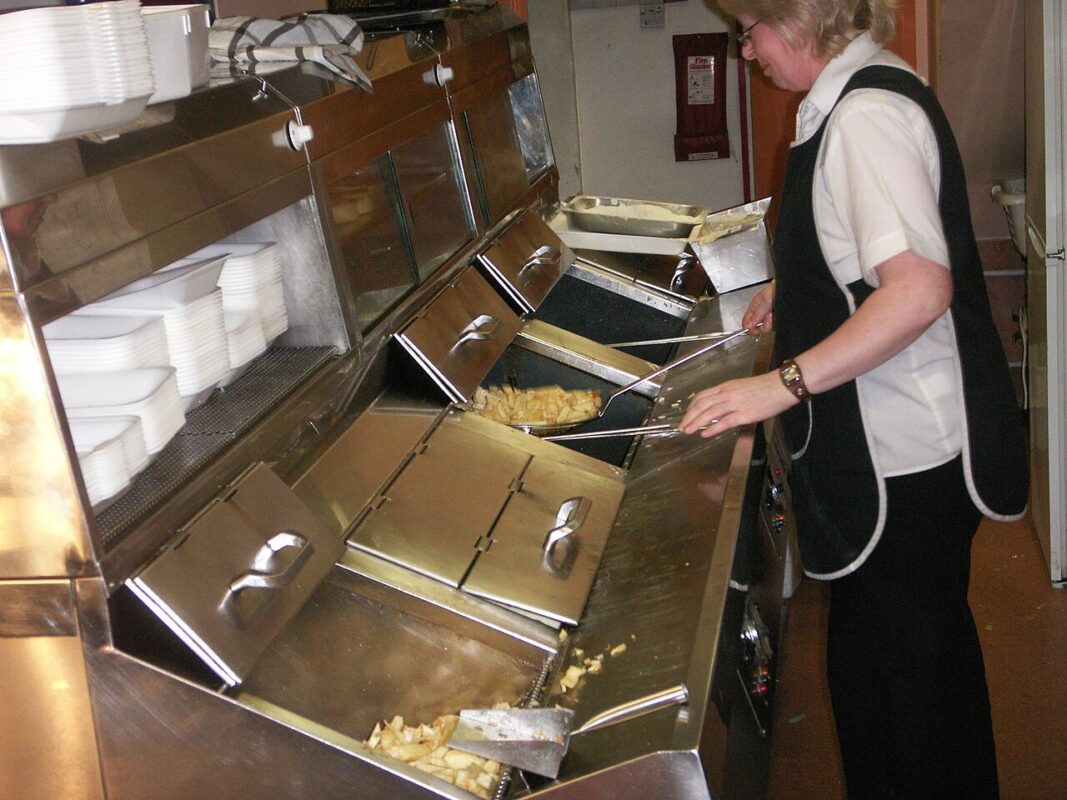
Long, hot frying can add a little more trans fat in vegetable oil, mostly when oil is abused: very high temperatures, long hours, little topping up. Under normal food service frying, the increase is small. Oil usually has to be thrown away for other reasons, like darkening, foaming and off flavours, long before trans fat becomes the issue. Our guide on how often to change fryer oil covers that.
There’s also a natural source: ruminant animals such as cows and sheep make small amounts of trans fats in their stomachs, so dairy and beef fat contain some. That’s not related to vegetable oil, and most laws treat it separately.
How Much Trans Fat in Vegetable Oil Is Normal
This is the question about trans fat in vegetable oil we hear most. Here are typical figures for well-refined oils, expressed as a percentage of total fatty acids.
| Oil | Typical trans fat after refining | Why |
|---|---|---|
| Refined coconut oil | very low, often below 0.1% | Almost no polyunsaturated fat to convert |
| Refined palm olein | low, usually below 0.5% | Low linoleic, almost no linolenic |
| High oleic sunflower oil | low, usually below 0.5% | Mostly oleic, less to convert |
| Refined sunflower oil | usually below 1% | High linoleic, no linolenic |
| Refined soybean oil | usually below 1% | Contains linolenic, the most sensitive |
| Refined canola oil | usually below 1% | Contains linolenic |
| Partially hydrogenated oil (old style) | often 20% to 50%+ | Made by partial hydrogenation |
The gap between normal refined oil and a PHO is huge. That’s why regulators focused on PHOs. Still, buyers who sell into strict markets now ask for the trans fat in vegetable oil to be measured and shown on the COA, and some ask for tighter limits than 1%.
The Rules Around the World
Rules on trans fat in vegetable oil change, so always check your own country’s current law. Here’s the broad picture.
WHO guidance
The WHO recommends that trans fat intake stays below 1% of total energy. Its REPLACE action package, launched in 2018, pushes countries to adopt one of two best practice policies: a limit of 2 grams of industrial trans fat per 100 grams of total fat in all foods, or a ban on making and using partially hydrogenated oils. You can read about it on the WHO REPLACE page.
European Union
EU Regulation 2019/649 limits industrial trans fat to 2 grams per 100 grams of fat in food sold to consumers, from April 2021. The full text is on EUR-Lex.
United States
The FDA decided that partially hydrogenated oils are no longer generally recognised as safe, with compliance dates from 2018 to 2020. That effectively removed PHOs from the US food supply. See the FDA page on trans fat.
Other countries
Many countries now follow one of the two WHO approaches, including several in Asia, the Middle East, Latin America and Europe outside the EU. Some set limits only for oils and fats, often alongside the Codex standard for named vegetable oils, which itself sets no trans fat limit. Others cover all foods. Some only require labelling. If you’re importing, check both the limit and how it’s measured: per 100 g of fat, or per 100 g of food.
What These Limits Mean for Refined Oil
The key point for buyers is this. A 2% limit on trans fat in vegetable oil, measured on the fat, is easy for normal refined oils to meet, because they usually sit well below 1%. The limits were designed to remove PHOs, not to ban ordinary refined oil.
But there are cases where it gets tight:
- Products made with a lot of refined soybean or canola oil from a refinery running very high deodorising temperatures
- Blends that include some partially hydrogenated fat from an old recipe
- Products where a frying oil is used far too long
- Countries with lower limits than 2%
In each case, the fix starts with knowing the trans fat in vegetable oil you’re buying, lot by lot.
How Trans Fat Is Measured
The standard method is gas chromatography of the fatty acid methyl esters, using a long, highly polar capillary column that can separate the trans isomers from the cis ones. AOCS Ce 1h-05 is the method many labs use. It gives the trans fat as a percentage of total fatty acids, broken down into trans oleic, trans linoleic and trans linolenic.
There’s also an infrared method, which is quicker but less precise at low levels. It’s useful for screening fats that may contain a lot of trans fat, less useful for refined oils at under 1%.
When you compare COAs, check:
- The method used
- Whether it reports total trans fatty acids or only some isomers
- Whether the result is per 100 g of fat or per 100 g of product
Our guide to the certificate of analysis for edible oil explains how to read the rest of the document.
How Refiners Keep Trans Fat in Vegetable Oil Low
Most of the control happens at the deodoriser. Good refineries manage trans fat in vegetable oil by:
- Keeping deodorising temperatures moderate. Lower temperature means less isomerisation. It’s a balance, because the oil still has to be fully deodorised.
- Controlling hold time. Less time at the highest temperature means less trans fat.
- Using good vacuum and stripping steam. This lets the refinery work at lower temperatures.
- Starting with fresh, good-quality crude oil. Crude oil with low free fatty acids needs less harsh deodorising.
- Never using partial hydrogenation. We don’t.
The same care also keeps other process contaminants low, such as 3-MCPD and glycidyl esters. Our post on 3-MCPD in palm oil explains those.
Replacing Partially Hydrogenated Oils
If you make margarine, shortening, biscuits, pastries or fried snacks, you may have moved away from PHOs already, which removes most of the trans fat in vegetable oil ingredients. If not, the most common replacements are:
| Need | Replacement options |
|---|---|
| Solid fat for bakery | Palm oil, palm stearin, palm kernel oil, coconut oil, interesterified blends |
| Frying fat with long life | Palm olein, high oleic sunflower oil, high oleic canola |
| Spreads and margarine | Blends of liquid oils with palm or coconut fractions, or interesterified fats |
| Snack frying | Palm olein, high oleic oils |
Fully hydrogenated oil is different from partially hydrogenated oil. When every double bond is saturated, there’s nothing left to turn trans, so fully hydrogenated fats contain very little trans fat. They’re often blended with liquid oils and then interesterified to make zero trans shortenings.
Palm products are a common answer because they’re naturally semi-solid. Our posts on palm stearin vs palm olein and coconut oil for bakery and confectionery look at how these fats are used.
Trans Fat and Labelling
Labelling rules for trans fat in vegetable oil differ a lot. Some countries require trans fat on every nutrition panel. Some allow a product to say zero trans fat if it’s under a small threshold per serving. Others don’t require it at all, but limit the amount instead.
If you pack retail oil, the label needs to match the local rule and the actual figure for the trans fat in vegetable oil you’re selling. A COA with a measured trans figure from your supplier makes that much easier. If you’re putting your own brand on oil, our private label vegetable oil page explains how we support label data.
Frying, Reuse and Trans Fat in Vegetable Oil
Restaurants often ask whether reusing frying oil builds up trans fat. The short answer is a little, but other problems come first. Here’s what really happens in a fryer:
- Oxidation produces polar compounds and off flavours
- Free fatty acids rise
- Colour darkens
- The oil foams and smokes earlier
Trans fat in vegetable oil rises slowly through all this, but at normal frying temperatures the change is small compared with the other damage. Oils with less polyunsaturated fat, like palm olein and high oleic sunflower oil, hold up better on every count. The cooking oil smoke point chart is useful when choosing a frying oil.
Trans Fat in Vegetable Oil, Oil by Oil
The table above gives the big picture. Here’s a bit more on each oil, the way we explain it to buyers on the phone.
Soybean oil
Soybean oil carries linolenic acid, usually 4.5% to 11% of its fatty acids. Linolenic acid has three double bonds and isomerises most easily in the deodoriser. So, together with a high iodine value, soybean oil is the oil where trans fat in vegetable oil needs the most attention at the refinery. Run gently, it stays comfortably under 1%. Run hot and long, it can creep above that. Our refined soybean oil specification lists the rest of the numbers we hold.
Canola oil
Canola is similar to soybean oil here, with linolenic acid around 8% to 10%. The same care applies. For frying, many food service buyers now choose high oleic canola or high oleic sunflower instead, partly because they form less trans fat and partly because they last longer.
Sunflower oil
Regular sunflower oil has lots of linoleic acid but almost no linolenic acid. It forms a little less trans fat in the deodoriser than soybean or canola, and well-refined lots sit comfortably under 1%. Our refined sunflower oil specification covers the full numbers.
Palm oil and palm olein
Palm oil is about half saturated and has only around 10% linoleic acid and almost no linolenic acid. So trans fat in vegetable oil made from palm stays very low after refining. People sometimes assume palm oil is a trans fat source because it’s semi-solid. It isn’t. Its firmness comes from saturated palmitic acid, which is a different thing entirely. That’s also why palm oil became one of the main replacements for partially hydrogenated fats.
Coconut oil
Coconut oil is over 90% saturated, so there’s almost nothing to convert. Refined coconut oil has the lowest trans fat of any common vegetable oil.
A Short History of Trans Fat
Partial hydrogenation was developed in the early 1900s and quickly took off. It turned cheap liquid oils into solid fats that kept well, didn’t need refrigeration and gave baked goods a good texture. For most of the twentieth century, margarine and shortening were made this way, and partially hydrogenated oils were the main source of trans fat in vegetable oil products worldwide.
From the 1990s, research linked industrial trans fats to heart disease, and the picture changed fast. Denmark became one of the first countries to limit industrial trans fat in 2003. Other countries followed, first with labelling, then with limits or bans. By the 2020s, partially hydrogenated oils had largely disappeared from the food supply in many markets, replaced by palm fractions, coconut oil, high oleic oils and interesterified fats. The trans fat entry has a fuller history if you’re interested.
A Checklist for Food Manufacturers
If you make food and need to keep trans fat in vegetable oil and finished products under control, this simple list covers most of it.
- Map every fat in your recipes. Oils, shortenings, margarines, frying fats and fat-containing ingredients.
- Get a trans fat figure for each one. Measured, on the COA, with the method stated.
- Remove any partially hydrogenated fat. Replace it with palm fractions, coconut oil, high oleic oils or interesterified fats.
- Set limits in your supplier contracts. For refined oils, 1% max as a percentage of fatty acids is common. Tighter if your market needs it.
- Watch your frying practice. Fresh oil topped up regularly, sensible temperatures and changing oil on time.
- Test finished products now and then. Especially after changing a supplier or a recipe.
None of this is complicated, but it needs doing. Most of the problems we see come from a single old ingredient nobody checked.
Questions to Ask Your Supplier
When you’re buying refined oil and trans fat in vegetable oil matters to you, ask:
- What’s your typical trans fat in vegetable oil for this product, and your maximum?
- Which method do you use to measure it?
- Is it on the lot COA, or only on request?
- Do you use any partial hydrogenation in your plant?
- Can you hold a tighter limit if my market needs it?
A good supplier answers all five without fuss. If you get vague answers, be careful. Our list of fake vegetable oil supplier warning signs is worth a read.
Common Myths About Trans Fat
- “All vegetable oil is full of trans fat.” No. Well-refined oil has very little. The high levels were in partially hydrogenated oils.
- “Cold oil is trans fat free, hot oil is full of it.” Heating adds a little, but normal cooking doesn’t turn good oil into a trans fat source.
- “Palm oil contains trans fat.” Refined palm oil naturally contains very little. Its firmness comes from saturated palmitic acid, not trans fat.
- “Zero trans on the label means none.” In some countries it means below a small threshold per serving.
Our Oils and Their Trans Fat Levels
Here are the oils we produce and export, with our standard specifications. We don’t use partial hydrogenation anywhere in our process. We test trans fat in vegetable oil by gas chromatography and can show it on every lot COA.
| Oil | Trans fat (as % of fatty acids) | FFA | Peroxide value | Moisture | Other key spec |
|---|---|---|---|---|---|
| RBD coconut oil | 0.5% max | 0.1% max | 1.0 meq/kg max | 0.1% max | Lauric acid 45% min |
| Refined palm olein CP10 | 1.0% max | 0.1% max | 2.0 meq/kg max | 0.1% max | Cloud point 10 C max |
| Refined palm olein CP8 | 1.0% max | 0.1% max | 2.0 meq/kg max | 0.1% max | Cloud point 8 C max |
| High oleic sunflower oil | 1.0% max | 0.1% max | 2.0 meq/kg max | 0.05% max | Oleic acid 75% min |
| Refined sunflower oil | 1.0% max | 0.1% max | 2.0 meq/kg max | 0.05% max | Iodine value 118 to 141 |
| Refined soybean oil | 1.0% max | 0.1% max | 2.0 meq/kg max | 0.05% max | Iodine value 124 to 139 |
| RBD canola oil | 1.0% max | 0.1% max | 2.0 meq/kg max | 0.05% max | Erucic acid under 2% |
These are contract maximums. Typical lots run lower, especially for palm and coconut. If your market needs a tighter limit, tell us and we’ll confirm what we can guarantee. All our oils are made under ISO 22000, HACCP and GMP with Halal certification, and ship worldwide in flexitanks, ISO tanks, IBCs, drums, bottles, jerrycans and tins.
FAQs on Trans Fat in Vegetable Oil
Does refined vegetable oil contain trans fat?
A small amount, usually well under 1% of the fatty acids, formed during deodorising. It’s far below the old partially hydrogenated oils.
Which cooking oil has the least trans fat?
Refined coconut oil and palm olein usually have the lowest levels, because they contain little polyunsaturated fat.
Is the 2% limit per 100 g of food or of fat?
In the EU and under the WHO best practice policy, it’s 2 g per 100 g of total fat.
Does frying create trans fat?
A little, mostly with abused oil. Other kinds of damage usually come first.
Can you show trans fat on the COA?
Yes. We measure trans fat in vegetable oil by gas chromatography and can include it on every lot COA.
Do you sell partially hydrogenated oil?
No.
Ask Us for Low Trans Fat Oil
If you need refined oil with a measured, low trans fat figure for your products or your market, send us the oil, quantity, port and any limit you have to meet. We’ll reply with prices, the full specification and a recent COA showing the trans fat result. Email info@dthcompanyltd.com, WhatsApp +66 91 765 9104, or use our contact page. You can also browse our product range or read more about us.