The iodine value of vegetable oils is one of those numbers that sits quietly on every certificate of analysis, and most buyers skip right past it. That’s a pity, because it tells you a lot. It says how unsaturated the oil is, how it will behave in the fryer, whether it will stay liquid in the cold, how long it will keep, and sometimes whether the oil in the tank is really what the label says.
We refine and export sunflower, soybean, palm, canola, coconut and high oleic oils, and we test the iodine value on every lot before it leaves the plant. This guide explains the iodine value of vegetable oils in plain words: what it measures, how labs test it, what the normal ranges are for each oil, and how to use it when you buy. At the end you’ll find our oils with their iodine values and full specifications, so you can see exactly what we ship.

Table of Contents
What the Iodine Value Measures
Oils are made mostly of fatty acids joined into triglycerides. Some fatty acids are saturated, meaning their carbon chain has no double bonds. Others are unsaturated, with one, two or three double bonds. Iodine reacts with those double bonds. So if you take 100 grams of oil and measure how many grams of iodine it can take up, you get a direct measure of how unsaturated it is.
That’s the whole idea. The iodine value of vegetable oils is written as grams of iodine per 100 grams of oil, often shortened to g I2/100 g, or just given as a number. A high number means lots of double bonds. A low number means a more saturated oil.
Some quick examples so the scale makes sense:
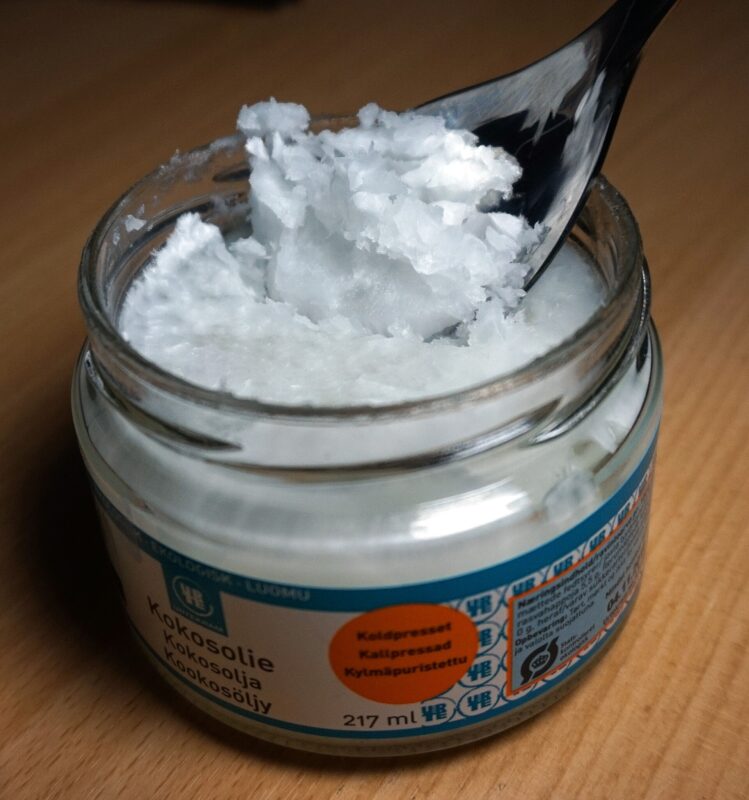
- Coconut oil is very saturated, with an iodine value of roughly 6 to 11
- Palm oil sits in the middle, around 50 to 55
- Olive oil is around 75 to 94, mostly from oleic acid
- Sunflower and soybean oils are high, around 118 to 141
- Linseed oil is very high, often above 170
If you remember nothing else about the iodine value of vegetable oils, remember that. Low number, more saturated, more stable, more solid. High number, more unsaturated, more liquid, less stable when heated.
Why the Iodine Value of Vegetable Oils Matters to Buyers
For a lab chemist, the iodine value of vegetable oils is just a test result. For a buyer, it answers practical questions.
Is this the oil I paid for?
Every named oil has a typical iodine range. Refined sunflower oil that comes back at 95 is not normal sunflower oil. It might be high oleic sunflower oil, which is fine if that’s what you ordered, or it might be blended with something cheaper. The iodine value of vegetable oils is one of the fastest first checks for identity.
How will it fry?
Double bonds are where oxidation starts, which is why the iodine value of vegetable oils is a decent hint about frying life. Oils with a high iodine value break down faster at frying temperatures, so they foam, darken and smell sooner. That’s why palm olein and high oleic sunflower oil last longer in commercial fryers than regular soybean or sunflower oil. Our post on how often to change fryer oil gets into fryer life in more detail.
Will it go cloudy in the cold?
More saturated oils go solid sooner as the temperature drops. Within palm olein, a slightly higher iodine value usually means a lower cloud point. That’s the difference you see between CP10 and CP8 olein. See CP8 vs CP10 palm oil for how that plays out on the shelf.
How long will it keep?
All else being equal, a higher iodine value means a shorter shelf life once the oil is opened or stored warm. It doesn’t mean high iodine oils are bad. It means they need better storage. Our guide on shelf life of sunflower oil, soybean and canola covers storage tips.
Iodine Value of Vegetable Oils: Typical Ranges
The table below gives the normal ranges most buyers and labs work with. They follow the ranges in the Codex standard for named vegetable oils, which you can find on the Codex Alimentarius list of standards, plus olive oil from its own Codex standard.
| Oil | Typical iodine value (g I2/100 g) | Main fatty acids |
|---|---|---|
| Coconut oil | 6.3 to 10.6 | Lauric, myristic |
| Palm kernel oil | 14.1 to 21.0 | Lauric, myristic |
| Palm stearin | 48 max | Palmitic, oleic |
| Palm oil | 50.0 to 55.0 | Palmitic, oleic |
| Palm olein | 56 min | Oleic, palmitic |
| Palm superolein | 60 min | Oleic, palmitic |
| Olive oil | 75 to 94 | Oleic |
| High oleic sunflower oil | 78 to 90 | Oleic |
| Groundnut (peanut) oil | 86 to 107 | Oleic, linoleic |
| Rice bran oil | 90 to 115 | Oleic, linoleic |
| Cottonseed oil | 100 to 123 | Linoleic, palmitic |
| Corn (maize) oil | 103 to 135 | Linoleic, oleic |
| Sesame oil | 104 to 120 | Linoleic, oleic |
| Canola (low erucic rapeseed) oil | 105 to 126 | Oleic, linoleic, linolenic |
| Sunflower oil | 118 to 141 | Linoleic, oleic |
| Soybean oil | 124 to 139 | Linoleic, oleic, linolenic |
| Grapeseed oil | 128 to 150 | Linoleic |
| Safflower oil | 136 to 148 | Linoleic |
| Linseed oil | about 170 to 200 | Linolenic |
Two things to notice. First, the ranges overlap. Corn, sesame, cottonseed and canola sit close to each other, so the iodine value of vegetable oils alone can’t tell them apart. You need the fatty acid profile for that. Second, crop, climate and seed variety move the number around inside the range. Sunflower seed grown in a hot season usually has more oleic acid and a lower iodine value than seed from a cooler season.
How Labs Measure the Iodine Value of Vegetable Oils
There are two main ways to get the iodine value of vegetable oils: titration, and calculation from the fatty acid profile.
The Wijs titration method
This is the classic method, written up as ISO 3961 and AOCS Cd 1d-92. In short:
- A weighed sample of dry, filtered oil is dissolved in a solvent.
- A known excess of Wijs solution (iodine monochloride in acetic acid) is added.
- The flask sits in the dark for a set time, usually 30 minutes to an hour, longer for very unsaturated oils.
- Potassium iodide and water are added, which turns the leftover iodine monochloride into free iodine.
- That free iodine is titrated with sodium thiosulfate, using starch as the indicator.
- A blank without oil is run the same way, and the difference gives the iodine absorbed.
The sample weight depends on the expected result. A coconut oil sample is much bigger than a soybean oil sample, because it takes up so little iodine. Getting that wrong is one of the most common reasons for odd results. You can read more about the reagent on the Wijs solution page.
There’s also the older Hanus method, using iodine monobromide. It gives slightly different numbers, so check which method a COA quotes if you compare two labs.
Calculated iodine value
Most modern refineries run a gas chromatograph for the fatty acid profile on every lot anyway. From that profile you can calculate the iodine value of vegetable oils directly, using the AOCS Cd 1c-85 method. Each unsaturated fatty acid has a factor:
| Fatty acid | Factor |
|---|---|
| Palmitoleic (C16:1) | 0.950 |
| Oleic (C18:1) | 0.860 |
| Linoleic (C18:2) | 1.732 |
| Linolenic (C18:3) | 2.616 |
| Gadoleic (C20:1) | 0.785 |
| Erucic (C22:1) | 0.723 |
Multiply each percentage by its factor and add them up. For example, an oil with 25% oleic, 62% linoleic and 0.2% linolenic gives 25 x 0.860 + 62 x 1.732 + 0.2 x 2.616, which is about 129. That’s right in the middle of the sunflower range.
Calculated and titrated figures for the iodine value of vegetable oils usually agree within a couple of units. If they don’t, something is off, either with the sample or with the oil.
How Refining Affects the Iodine Value
People often ask whether refining changes the iodine value of vegetable oils. Normal refining, meaning degumming, neutralising, bleaching and deodorising, changes it very little. The fatty acids stay the same. A crude soybean oil at 130 will give a refined soybean oil at about 130.
What does change the number:
- Fractionation. Splitting palm oil into olein and stearin moves the liquid, more unsaturated part one way and the solid part the other. Olein goes up, stearin goes down. Our post on palm stearin vs palm olein explains this.
- Hydrogenation. Adding hydrogen to double bonds lowers the iodine value, and is how liquid oils were turned into shortening. Partial hydrogenation also creates trans fats, which is why it’s now restricted in many countries.
- Interesterification. Rearranges fatty acids between triglycerides. The overall iodine value stays about the same, but the melting behaviour changes.
- Blending. Mixing oils gives a weighted average.
- Oxidation and heat damage. Over long frying, double bonds get broken and the iodine value of vegetable oils slowly drops. Used frying oil can read several units lower than fresh oil.
Using the Iodine Value of Vegetable Oils to Check Blends
Because the iodine value of a blend is close to the weighted average of its parts, you can use it to check a blend roughly. Say a buyer wants 70% palm olein at about 57 and 30% soybean oil at about 130. The blend should come out at 0.7 x 57 + 0.3 x 130, which is about 79.
If the blend comes back at 65, there’s less soybean oil in it than promised. If it comes back at 95, there’s more. It’s not precise enough to replace a fatty acid profile, but it’s a fast check, and many buyers use it on arrival.
It’s also the first red flag in a lot of adulteration cases. Sunflower oil cut with palm olein shows a lower iodine value than it should. Our guide on how to detect adulterated cooking oil covers that in more depth.
Iodine Value and Health
This part needs care, because the internet is full of oversimplified claims. The iodine value of vegetable oils tells you about unsaturation. It doesn’t tell you on its own whether an oil is healthy.
What it does tell you:
- A higher number usually means more polyunsaturated fat, mostly linoleic acid, and often omega 3 linolenic acid in soybean and canola.
- A lower number in liquid oils usually means more monounsaturated oleic acid, as in olive and high oleic sunflower oil.
- A very low number means a saturated fat, as in coconut and palm kernel oil.
Nutrition advice usually focuses on the overall fatty acid balance and on avoiding industrial trans fats. If you want the bigger picture, our post on trans fat in vegetable oil is a good next read.
Iodine Value in Industrial Uses
The iodine value of vegetable oils matters outside the kitchen too.
- Paints and varnishes. Drying oils, with an iodine value above about 150, harden in air. Linseed oil is the classic example. Semi-drying oils like soybean and sunflower are in between. Non-drying oils like olive, palm and coconut stay liquid or soft.
- Soap. Low iodine oils like coconut and palm kernel make hard, long-lasting bars. High iodine oils make softer soap that can go rancid sooner. See our coconut oil for soap making guide.
- Biodiesel. The European biodiesel standard EN 14214 sets a maximum iodine value of 120, which limits how much high iodine oil can go into the feedstock.
- Margarine and bakery fats. Formulators watch the iodine value of vegetable oils when designing fat blends with the right firmness.
Iodine Value of Vegetable Oils, One Oil at a Time
The table gives the ranges. Here’s what those ranges mean in daily buying, oil by oil.
Sunflower oil
Regular sunflower oil is linoleic-rich and sits around 118 to 141. Seed from warmer growing areas tends to come in at the lower end, seed from cooler areas at the higher end. If you buy sunflower oil from more than one origin, expect the iodine value of vegetable oils from each source to differ by a few units. That’s normal. What isn’t normal is regular sunflower oil coming in below 110 with no explanation. Our guide on high oleic vs regular sunflower oil shows how far apart the two types really are.
Soybean oil
Soybean oil runs from about 124 to 139 and carries some linolenic acid, the omega 3 fatty acid with three double bonds. That’s part of why soybean oil can pick up a beany or fishy note when it’s stored badly or fried too long. For buyers who need longer fryer life, high oleic soybean oil has a much lower iodine value. We compare them in high oleic soybean oil vs regular soybean oil.
Palm oil and its fractions
Palm oil is the one where the iodine value of vegetable oils is most useful day to day. Whole palm oil is around 50 to 55. Olein is 56 or higher, superolein 60 or higher, stearin 48 or lower. In practice, the iodine value is how refiners and buyers track how well a fractionation has worked. A palm olein lot that reads 54 has too much stearin left in it and will likely turn cloudy early. If you buy crude palm oil, our crude palm oil specification post has the full list of numbers to check.
Canola oil
Canola sits around 105 to 126 on the scale used for the iodine value of vegetable oils. It has a good share of oleic acid and some linolenic acid, so it falls in the middle of the liquid oils. It’s often used as a check against mislabelled rapeseed oil, though for that the erucic acid figure on the fatty acid profile is the real test.
Coconut and palm kernel oil
These lauric oils sit far below everything else, at roughly 6 to 11 for coconut and 14 to 21 for palm kernel. A coconut oil lot reading 15 or more would make us ask questions straight away, because it hints at another oil mixed in. Our post on lauric acid in coconut oil explains why coconut oil is so different.
Corn oil
Corn oil runs from about 103 to 135, mostly linoleic and oleic. It overlaps with several other oils, so on its own the number isn’t a strong identity test. The refined corn oil specification post covers the rest of the numbers.
Planning Storage Around the Iodine Value
If you’re a distributor or a food factory holding stock for months, the iodine value of vegetable oils is a simple planning tool. Oils at the top of the scale need the most care.
- Keep high iodine oils such as sunflower, soybean and canola in full, closed tanks with as little headspace as you can manage.
- Keep them cool and out of the light. Every 10 C rise in storage temperature speeds up oxidation noticeably.
- Use them first. Sell or use the high iodine oils before the low iodine ones.
- For long storage, ask your supplier about added antioxidants where your local rules allow them.
Low iodine oils like palm olein and coconut oil are more forgiving on oxidation, but they bring their own issue: they go cloudy or solid in the cold. So they need gentle warming in cool climates, not cold storage. One simple rule many warehouse managers use: the lower the iodine number, the more you think about temperature. The higher the number, the more you think about air and time.
What to Look For on a COA
When you get a certificate of analysis, check these points on the line for the iodine value of vegetable oils:
- The value falls inside the normal range for that oil.
- The method is stated (Wijs, calculated, or other).
- It agrees with the fatty acid profile on the same COA.
- It’s in line with previous lots from the same supplier.
If the iodine value jumps between lots for the same oil, ask why. Seasonal crop variation can explain a few units. Ten or twenty units usually can’t. Our guide on the certificate of analysis for edible oil explains every line on the document.
Common Mistakes Around the Iodine Value of Vegetable Oils
- Treating it as a quality grade. A higher iodine value of vegetable oils isn’t better or worse. It just has to match the oil.
- Comparing Wijs and Hanus numbers. They differ slightly. Compare like with like.
- Testing wet or cloudy samples. Water and solids throw off the weighing and the reaction.
- Using one number to identify an oil. Overlapping ranges mean you also need the fatty acid profile.
- Forgetting the season. Crop changes can shift the number within the range, especially in sunflower oil.
Iodine Value of Vegetable Oils We Supply
Here are the oils we produce and export, with our standard specifications. The iodine value of vegetable oils in this list is tested on every lot and printed on the COA, alongside the full fatty acid profile.
| Oil | Iodine value | FFA | Peroxide value | Moisture | Other key spec |
|---|---|---|---|---|---|
| Refined sunflower oil | 118 to 141 | 0.1% max | 2.0 meq/kg max | 0.05% max | Linoleic acid 48 to 74% |
| High oleic sunflower oil | 78 to 90 | 0.1% max | 2.0 meq/kg max | 0.05% max | Oleic acid 75% min |
| Refined soybean oil | 124 to 139 | 0.1% max | 2.0 meq/kg max | 0.05% max | Linolenic acid 4 to 11% |
| RBD canola oil | 105 to 126 | 0.1% max | 2.0 meq/kg max | 0.05% max | Erucic acid under 2% |
| Refined palm olein CP10 | 56 min | 0.1% max | 2.0 meq/kg max | 0.1% max | Cloud point 10 C max |
| Refined palm olein CP8 | 58 min | 0.1% max | 2.0 meq/kg max | 0.1% max | Cloud point 8 C max |
| RBD coconut oil | 7 to 11 | 0.1% max | 1.0 meq/kg max | 0.1% max | Lauric acid 45% min |
All our oils are made under ISO 22000, HACCP and GMP with Halal certification. We ship in flexitanks, ISO tanks, IBCs, drums, PET bottles, jerrycans and tins, to buyers around the world. If you need a tighter iodine range for a formulation, for example a narrow palm olein range for a margarine line, tell us and we’ll confirm what we can hold.
For the full numbers on each oil, see our refined sunflower oil specification, refined soybean oil specification and RBD canola oil specification pages.
FAQs on the Iodine Value of Vegetable Oils
What is a good iodine value for cooking oil?
There’s no single good number. It has to match the oil type. Sunflower oil should be about 118 to 141, palm olein 56 or above, coconut oil about 6 to 11.
Which oil has the highest iodine value?
Among common oils, linseed oil, often above 170. Among cooking oils, safflower, grapeseed, sunflower and soybean are at the top.
Which oil has the lowest iodine value?
Coconut oil, followed by palm kernel oil.
Does frying change the iodine value?
Yes, slowly. Heat breaks double bonds, so the iodine value drops over long frying.
Is the iodine value the same as the peroxide value?
No. The iodine value of vegetable oils measures unsaturation. The peroxide value measures early oxidation. Our free fatty acid and peroxide value guide explains the second one.
Can you supply oil with a specific iodine value?
Within the natural range of each oil, yes. Tell us the target and we’ll confirm.
Ask Us for a COA and Price
If you’re buying refined oil and want to see the iodine value of vegetable oils from our actual lots, ask us for a recent COA. Tell us which oil, the quantity and your port, and we’ll send it with a price and the full specification. Email info@dthcompanyltd.com, WhatsApp +66 91 765 9104, or use our contact page. You can also browse our product range or read more about us. For background on testing methods, the AOCS publishes the official methods most labs follow, and the iodine value entry gives a short history of the test.