


Ask ten chicken shops what the best oil for deep frying chicken is and you’ll get about six answers. Peanut oil, palm olein, canola, soybean, beef tallow, “whatever’s cheapest this month.” Most of them have a point. But if you fry chicken every day, for paying customers, the choice of oil decides how crisp the skin gets, how the chicken tastes on day three of the oil, how often you change the fryer, and how much you spend in a year.
We make and export refined frying oils to restaurants, fried chicken chains, caterers and distributors in many countries. This guide is how we’d explain the best oil for deep frying chicken to a new customer across the table: what matters, how the common oils compare, and how to make your oil last. At the end you’ll find the frying oils we sell, with their specifications and pack sizes.
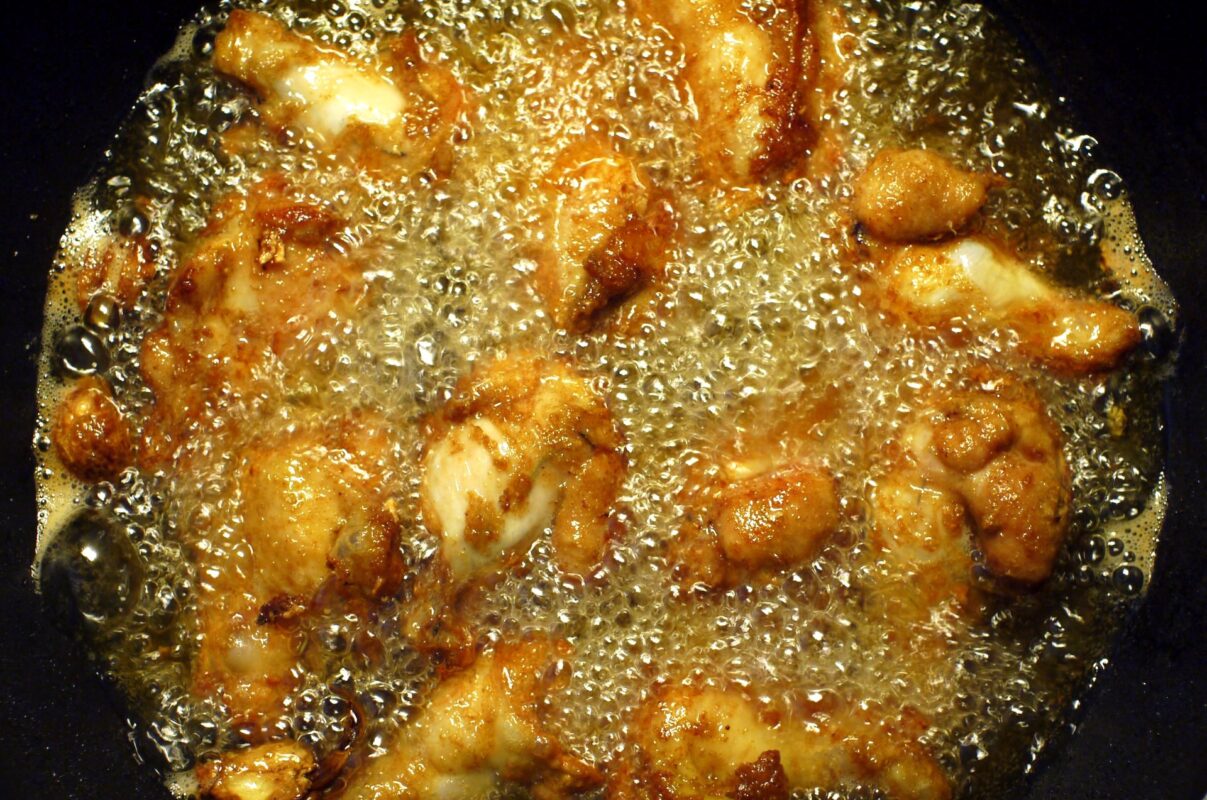
Table of Contents
What Makes the Best Oil for Deep Frying Chicken
Forget the marketing for a minute. For chicken, a frying oil has four jobs.
- Stay stable at frying heat. Chicken is usually fried at 160 to 180 C (about 325 to 350 F), often for 10 to 15 minutes for bone-in pieces. That’s a long time at temperature.
- Taste clean. Chicken picks up flavour from the oil, especially the breading. A neutral oil lets your seasoning come through.
- Give a crisp, dry coating. Some oils leave chicken greasier than others, and old oil makes everything soak up more fat.
- Last a reasonable number of days. Chicken is a hard food on oil. Breading, flour, spices, salt, water from the meat and fat from the skin all go into the fryer.
The best oil for deep frying chicken is the one that does all four at a price that works for you. That’s why there isn’t one answer for every kitchen.
Why Chicken Is So Hard on Frying Oil
People looking for the best oil for deep frying chicken often don’t realise how much chicken punishes oil compared with, say, French fries.
- Water. Raw chicken releases water into hot oil. Water breaks the oil down through hydrolysis, raising free fatty acids.
- Chicken fat. The skin renders fat into the fryer. Chicken fat is less stable than refined frying oil and changes the oil’s flavour over time.
- Breading and flour. Loose flour burns at the bottom of the fryer and darkens the oil.
- Salt and spices. Salt speeds up oil breakdown. Spices like paprika and pepper add colour and bitter notes.
- Long fry times. A bone-in thigh may sit in the oil for 12 to 15 minutes.
So the best oil for deep frying chicken has to be tougher than an oil you’d use for chips. Stability matters more than almost anything else.
The Best Oil for Deep Frying Chicken: Main Candidates Compared
Here’s how the common candidates for the best oil for deep frying chicken stack up. The ratings are from our experience and our customers’ feedback, not lab rankings.
| Oil | Frying stability | Flavour | Typical price level | Notes for chicken |
|---|---|---|---|---|
| Refined palm olein | Very good | Neutral | Low | Crisp coating, long life, the standard in hot countries |
| High oleic sunflower oil | Excellent | Very clean | Higher | Longest fryer life of the liquid oils |
| High oleic canola | Excellent | Clean | Higher | Popular with chains in North America |
| Peanut (groundnut) oil | Good | Light nutty | High | Traditional favourite, but an allergen |
| Refined canola oil | Fair to good | Clean | Medium | Fine for lower volume |
| Refined soybean oil | Fair | Neutral, can turn fishy | Low | Cheap but shorter life |
| Refined sunflower oil (regular) | Fair | Clean | Medium | Breaks down faster under long frying |
| Corn oil | Fair to good | Slight corn note | Medium | Common in some markets |
| Beef tallow or lard | Good | Rich, meaty | Varies | Great taste, but not for every customer |
If you want the short version: for most commercial kitchens, the best oil for deep frying chicken is either refined palm olein or a high oleic oil. Palm olein wins on cost. High oleic oils win on oil life and on a liquid, clear oil in cooler climates.
Palm Olein: The Workhorse
Refined palm olein is the most widely used choice as the best oil for deep frying chicken in Asia, Africa, the Middle East and much of Latin America. There are good reasons.
- It’s naturally more saturated than seed oils, so it oxidises more slowly at frying heat.
- It has almost no linolenic acid, the fatty acid that makes soybean and canola oil turn fishy.
- It gives a crisp, dry finish that customers like on fried chicken.
- It’s usually the cheapest refined oil per tonne.
The catch is temperature. Palm olein can turn cloudy or partly solid in a cool kitchen or storeroom. That doesn’t hurt the oil, but it looks bad in a clear bottle and needs warming before use. In cooler climates, CP8 olein, with a lower cloud point, handles better than CP10. Our post on CP8 vs CP10 palm oil explains the difference.
For many fried chicken shops in warm countries, palm olein is simply the best oil for deep frying chicken on cost per kilo of chicken sold.
High Oleic Oils: Longest Fryer Life
High oleic sunflower oil and high oleic canola have been bred to carry mostly oleic acid, the same fatty acid that makes olive oil stable. Oleic acid has one double bond. Linoleic acid, the main fat in regular sunflower oil, has two. Fewer double bonds means slower breakdown in the fryer.
In practice, a high oleic oil in a well-managed chicken fryer can last noticeably longer than regular sunflower or soybean oil. Some customers tell us they get close to double the days. It stays liquid and clear in a cold kitchen, tastes very clean and has less saturated fat than palm olein.
It costs more per tonne. Whether it’s the best oil for deep frying chicken in your kitchen depends on whether the longer life pays for the higher price. For high volume chains, it often does. Our post on high oleic vs regular sunflower oil has the numbers.
Peanut Oil: The Traditional Choice
Peanut oil has a long reputation as the best oil for deep frying chicken, especially in the United States. It has a high smoke point, good stability and a light flavour many people like.
The problems are price and allergens. Highly refined peanut oil is often considered low risk for allergy, but many restaurants and food service buyers now avoid peanut oil entirely to keep things simple. If you’re choosing the best oil for deep frying chicken for a chain or a school canteen, that matters.
Soybean, Canola and Regular Sunflower Oil
These oils are cheaper per litre than high oleic oils and widely available. They fry chicken well when the oil is fresh. They just don’t last as long.
- Soybean oil contains linolenic acid and can develop a fishy or painty smell after long frying.
- Regular canola oil has the same issue, a bit less.
- Regular sunflower oil has a lot of linoleic acid and breaks down faster than palm or high oleic oils.
For small kitchens that change oil often anyway, they’re perfectly fine. For high volume chicken frying, they’re rarely the best oil for deep frying chicken once you count the extra oil changes. Our comparison of canola oil vs soybean oil for commercial frying goes into this.
What About Smoke Point?
Smoke point gets a lot of attention when people discuss the best oil for deep frying chicken, but it’s not the main thing. Almost every refined frying oil has a smoke point well above 200 C, comfortably above normal frying temperatures. What matters more is how the oil holds up over many hours at 170 C with chicken going through it.
That said, smoke point falls as oil ages and free fatty acids rise. When fresh oil starts smoking at your normal temperature after a few days, it’s telling you it’s worn out. Our cooking oil smoke point chart lists fresh values for each oil.
Frying Temperatures for Chicken
Even the best oil for deep frying chicken won’t save chicken fried at the wrong temperature.
| Item | Typical oil temperature | Typical time |
|---|---|---|
| Bone-in pieces, open fryer | 165 to 175 C (330 to 350 F) | 12 to 15 minutes |
| Bone-in pieces, pressure fryer | about 160 to 170 C (320 to 340 F) | 8 to 12 minutes |
| Boneless strips and tenders | 170 to 180 C (340 to 355 F) | 4 to 6 minutes |
| Wings | 170 to 180 C (340 to 355 F) | 8 to 10 minutes |
| Nuggets (pre-cooked) | 175 to 180 C (350 to 355 F) | 3 to 4 minutes |
These are starting points. Always check that the thickest part of the chicken reaches a safe internal temperature. The USDA’s safe minimum temperature chart gives 74 C (165 F) for poultry.
Don’t push the oil hotter to speed things up. Every 10 C above what you need shortens oil life. Too cold is just as bad: the chicken soaks up oil and comes out greasy.
How to Make the Best Oil for Deep Frying Chicken Last Longer
Choosing the best oil for deep frying chicken is half the job. Looking after it is the other half.
- Filter every day. At least once a day, more in busy shops. Filtering removes burnt breading that darkens and breaks down the oil.
- Top up with fresh oil. Topping up replaces oil the food carries away and slows down the build-up of breakdown products.
- Shake off loose breading before the chicken goes in.
- Don’t salt over the fryer. Salt in the oil speeds up breakdown.
- Turn the fryer down when idle. Keep it at a lower standby temperature during quiet hours.
- Cover fryers at night. Less air, less light, slower oxidation.
- Keep chicken fryers separate from fish and from fries if you can. Fish flavour transfers, and fries don’t need the same heavy oil.
- Clean fryers properly and rinse out all cleaning chemicals before refilling.
Our guide on how often to change fryer oil gives the warning signs that it’s time to dump the oil.
Open Fryers vs Pressure Fryers
The type of fryer changes which is the best oil for deep frying chicken in your kitchen.
Open fryers are the standard in most shops. The oil is exposed to air the whole time it’s hot, so oxidation is the main enemy. Stable oils like palm olein and high oleic sunflower oil earn their keep here.
Pressure fryers, used by many fried chicken chains, seal the lid during cooking. Steam from the chicken builds pressure, which lets the chicken cook faster at a slightly lower oil temperature and keeps it juicy. Less air gets to the oil during the cook, but much more water vapour does, and water speeds up hydrolysis. That means free fatty acids rise faster. In pressure fryers, many operators find a stable oil with low starting FFA makes a real difference to oil life. Our refined oils leave the plant at 0.1% FFA max for exactly this reason.
Whichever fryer you use, follow the maker’s guidance on oil level and temperature. Running the oil too low in the pot makes it overheat at the elements and break down fast.
The Best Oil for Deep Frying Chicken by Region
Taste expectations differ around the world, and so does what’s available at a sensible price. Here’s roughly what we see.
- Southeast Asia, South Asia and Africa. Palm olein is the default. It’s local, cheap and stable in the heat. Many shops would call it the best oil for deep frying chicken without a second thought.
- Middle East. Palm olein for price, sunflower oil and high oleic sunflower oil for premium and health-focused brands. Tins of 16 to 18 litres are common.
- North America. High oleic canola and soybean blends dominate chains. Peanut oil still has fans in independent shops.
- Europe. High oleic sunflower oil and rapeseed oil are widely used, with many brands avoiding palm oil for consumer reasons.
- Latin America. Palm olein, soybean oil and sunflower oil all show up, depending on the country.
If you’re opening in a new market, look at what the successful local competitors use. Customers there already know that taste.
Storing Frying Oil Before It Reaches the Fryer
Even the best oil for deep frying chicken can be spoiled before it’s opened. Keep jerrycans and tins in a cool, dry, shaded store, off the floor and away from the fryers and ovens. Don’t leave them in direct sun in a yard or on a delivery truck all day. Use stock in order of delivery. Once a jerrycan is opened, close it tightly and use it within a few weeks. Palm olein that has gone cloudy in a cold store just needs gentle warming before use, it isn’t spoiled. Our guide on shelf life of sunflower oil, soybean and canola covers storage in more detail.
Testing Fryer Oil
To get the most from the best oil for deep frying chicken, many chicken chains use a simple tester that measures total polar materials, or TPM, the general breakdown products in fried oil. Some countries set a legal limit, often around 24% to 27% TPM. Below that, the oil is usable. Above it, it has to go.
Other signs your oil is done:
- Dark colour, even right after filtering
- Foam that doesn’t settle
- Smoke at normal frying temperature
- A bitter, rancid or fishy smell
- Chicken that comes out darker and greasier than usual
If your oil hits these signs much faster than it used to, either the oil quality has changed or your frying practice has. Both are worth checking.
Cost Per Kilo of Chicken, Not Price Per Litre
This is where a lot of buyers get it wrong. The cheapest oil per litre is not always the cheapest oil in the fryer.
Say a cheap oil lasts four days and a more stable oil lasts seven. If the stable oil costs 30% more per litre but lasts 75% longer, it’s cheaper to run. On top of that, you spend less labour on oil changes and you get more consistent chicken.
So when you compare offers for the best oil for deep frying chicken, do it on cost per kilo of chicken fried. Run a trial: one fryer with each oil, same menu, same filtering routine, and count the days.
A Simple Fryer Trial
If you can’t decide, test it. Pick two fryers that get similar use. Fill one with your current oil and one with the oil you’re considering. Keep the menu, the filtering and the top-up routine the same. Write down the date you filled each fryer, how much oil you topped up each day, and the day you had to dump it. Taste the chicken on day one, day three and the last day. After two or three rounds you’ll have a real answer, in your kitchen, with your chicken. That beats any chart, including ours.
Health and Labelling Points
Customers ask more questions about the best oil for deep frying chicken than they used to. A few points are worth knowing.
- Trans fat. Well-refined frying oils contain very little trans fat. The big levels were in old partially hydrogenated shortenings, which most countries now restrict. Our post on trans fat in vegetable oil explains this.
- Saturated fat. Palm olein has more than seed oils. High oleic oils have less.
- Allergens. Peanut oil may need allergen labelling or a notice for customers.
- Halal. Many chicken businesses need halal-certified oil. All our oils carry halal certification.
Which Oil We Recommend for Different Kitchens
Here’s how we usually advise customers asking about the best oil for deep frying chicken.
| Kitchen type | Our usual suggestion | Why |
|---|---|---|
| Busy fried chicken shop, warm climate | Refined palm olein CP10 | Low cost, long life, crisp finish |
| Fried chicken shop, cooler climate | Palm olein CP8 or high oleic sunflower oil | Stays clear and liquid |
| Fast food chain, high volume | High oleic sunflower oil | Longest fryer life, consistent results |
| Small restaurant, low volume | Refined soybean, canola or sunflower oil | Lower price, oil changed often anyway |
| Caterer or hotel, mixed menu | Palm olein or high oleic sunflower oil | Handles chicken, fish and fries |
| Health-focused brand | High oleic sunflower or canola | Lower saturated fat, clean label |
Our Frying Oils for Chicken
These are the oils we sell as the best oil for deep frying chicken, made and shipped worldwide. Each lot is produced under ISO 22000, HACCP and GMP, with halal certification and its own certificate of analysis.
| Oil | FFA | Peroxide value | Moisture | Key spec | Packing |
|---|---|---|---|---|---|
| Refined palm olein CP10 | 0.1% max | 2.0 meq/kg max | 0.1% max | Cloud point 10 C max, iodine value 56 min | 20 L jerrycans, 18 L tins, drums, flexitank |
| Refined palm olein CP8 | 0.1% max | 2.0 meq/kg max | 0.1% max | Cloud point 8 C max | 20 L jerrycans, 5 L bottles, drums |
| High oleic sunflower oil | 0.1% max | 2.0 meq/kg max | 0.05% max | Oleic acid 75% min | 20 L jerrycans, drums, IBC |
| Refined sunflower oil | 0.1% max | 2.0 meq/kg max | 0.05% max | Iodine value 118 to 141 | 1 to 5 L bottles, 20 L jerrycans |
| Refined soybean oil | 0.1% max | 2.0 meq/kg max | 0.05% max | Iodine value 124 to 139 | 20 L jerrycans, drums, flexitank |
| RBD canola oil | 0.1% max | 2.0 meq/kg max | 0.05% max | Erucic acid under 2% | 5 L bottles, 20 L jerrycans |
For fried chicken businesses, most customers take 18 or 20 litre jerrycans or tins. Distributors usually take a full container of jerrycans, or bulk in a flexitank for local filling, sometimes under their own brand through our private label vegetable oil service. Our minimum order quantity for bulk cooking oil page explains order sizes.
FAQs on the Best Oil for Deep Frying Chicken
What oil do most fried chicken restaurants use?
It depends on the region. Palm olein dominates in Asia, Africa and the Middle East. In North America and Europe, high oleic canola, high oleic sunflower, peanut oil and soybean blends are common.
Is palm olein the best oil for deep frying chicken?
Yes. It’s stable, neutral, crisp and low cost, which makes it one of the most popular choices.
What is the healthiest option among frying oils for chicken?
High oleic sunflower or high oleic canola. They’re stable and lower in saturated fat.
How long should frying oil last for chicken?
With daily filtering and topping up, often 4 to 8 days in a busy shop, depending on the oil and volume.
Can I mix palm olein with sunflower oil?
Yes, many kitchens do. The blend behaves between the two.
Do you sell oil in jerrycans for restaurants?
Yes. 18 and 20 litre jerrycans and tins are our most common packs for chicken businesses.
Get a Frying Oil Quote
Tell us how much chicken you fry, your climate and your port, and we’ll suggest the best oil for deep frying chicken for your kitchen, with prices for jerrycans, tins or bulk. We can send samples so you can run your own fryer trial first. See our guide on how to request edible oil samples. Email info@dthcompanyltd.com, WhatsApp +66 91 765 9104, or use our contact page. You can also browse our product range, or read more on deep frying as a cooking method.





4 thoughts on “Best Oil for Deep Frying Chicken: 7 Proven Expert Tips”